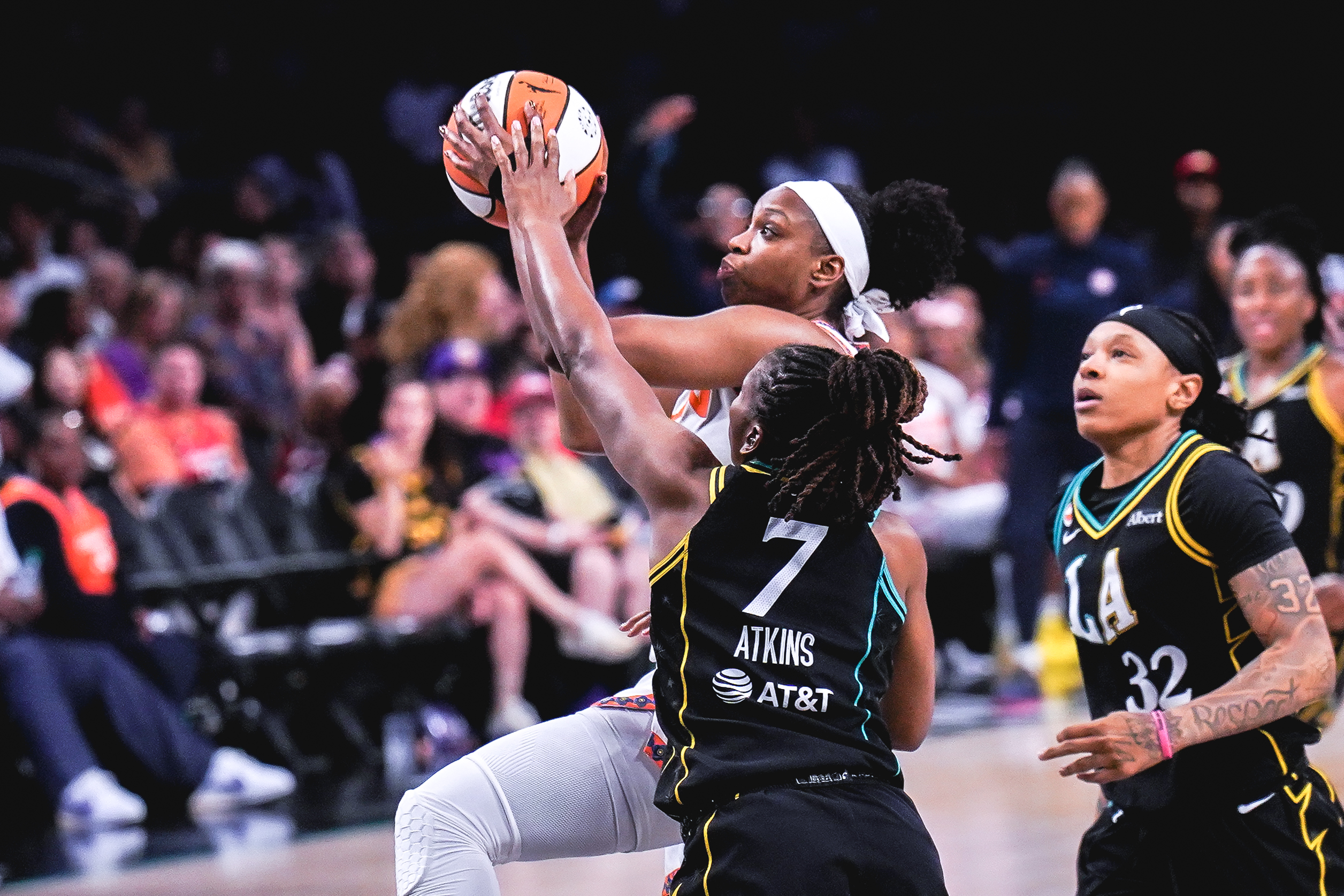
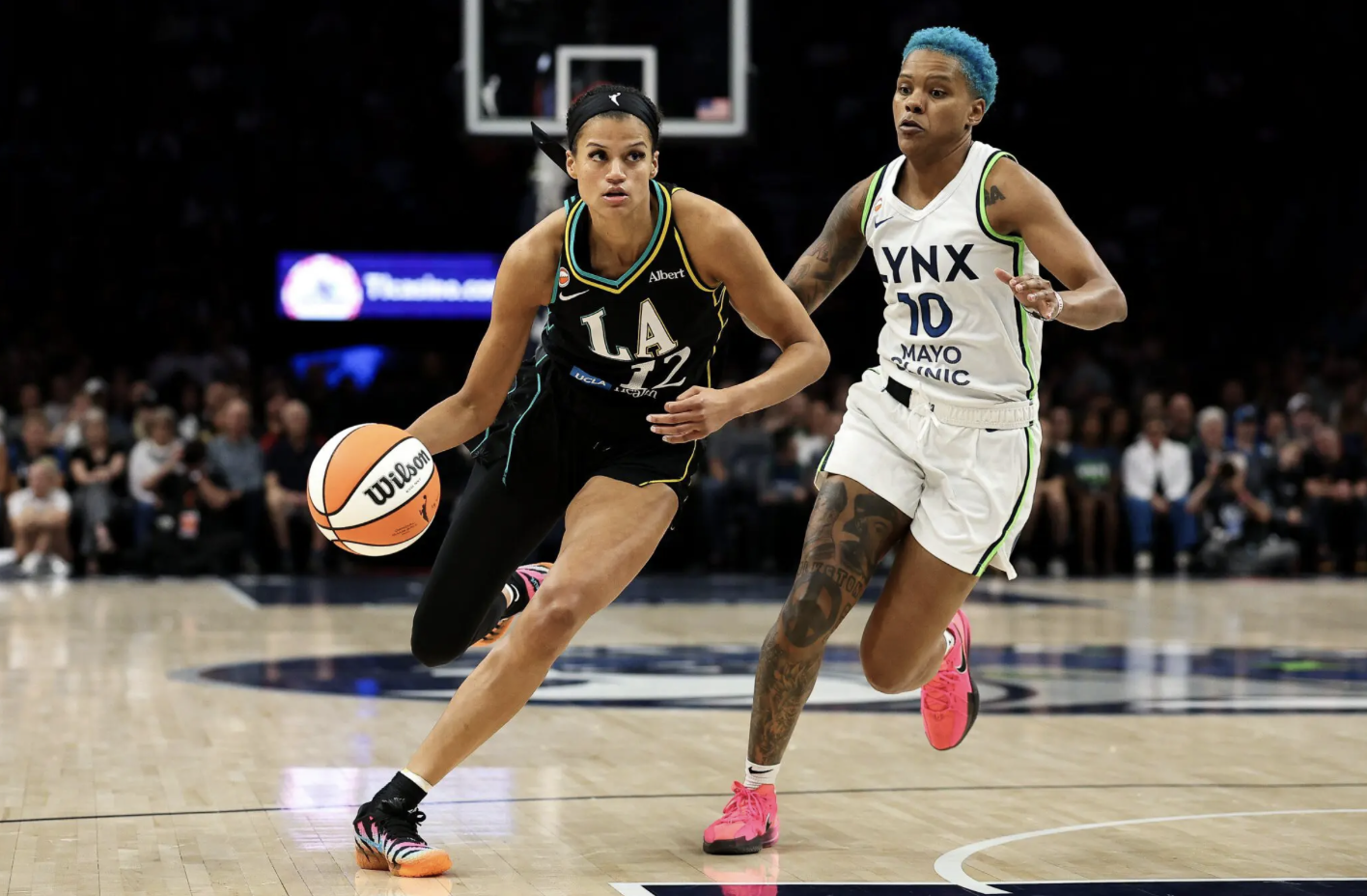
Rae Burrell and Dearica Hamby the LA to an upset win in Thursday’s Sparks vs Lynx matchup. (Matt Krohn/Getty Images)
The Lynx said they played terribly. But how much of their bad night was actually created by Los Angeles?
The timing is almost too perfect.
The Sparks spent the trade deadline making it clear they were thinking beyond this season. They traded leading scorer Kelsey Plum to Phoenix, and special adviser Farhan Zaidi had already acknowledged that Los Angeles needed to take “a long-term perspective rather than focusing on the rest of the season.”
Then the Sparks went to Minnesota and beat the best team in the WNBA.
The Lynx entered the game on a 10-game winning streak. They’re deep, experienced, defensively difficult and led by Napheesa Collier. They’re the kind of team everyone else in the league is measuring themselves against.
Los Angeles beat them 89–82.
Afterward, Cheryl Reeve didn’t sugarcoat her assessment. She thought Minnesota played poorly essentially across the board.
She wasn’t wrong.
But there’s another question worth asking:
Did Minnesota play badly, or did Los Angeles make Minnesota play badly?
Because those aren’t quite the same thing.
For a While, Everything Looked Normal
Minnesota scored the game’s first five points and eventually built a 10-point first-quarter lead.
Then Los Angeles answered with a 15–4 run and finished the quarter down only one.
Two numbers from that stretch tell two different stories: Minnesota started 1-for-10 from three, while Los Angeles held a 14–8 advantage in paint scoring.
The first looks like Minnesota having an unusually bad shooting night.
The second suggests the Sparks weren’t simply waiting around for the Lynx to miss.
That’s the difficulty with explaining an upset through a box score. Some misses are just misses. Others are the end result of a possession that became uncomfortable several decisions earlier.
And Los Angeles kept making Minnesota uncomfortable.
Nobody Had to Become Kelsey Plum
Maybe the most interesting number in the Sparks’ box score is 17.
That’s how many points their leading scorer, Rae Burrell, had.
Dearica Hamby and Nneka Ogwumike each scored 16. Erica Wheeler and Cameron Brink each added 12.
Five players reached double figures. Nobody scored more than 17.
Los Angeles had just traded a player averaging nearly 24 points per game, yet it didn’t beat Minnesota because somebody suddenly replaced Plum’s production.
It distributed the problem.
Without one obvious offensive focal point, Minnesota had to keep identifying where the next threat was coming from. Hamby could attack inside. Burrell could stretch the floor. Ogwumike could score at multiple levels. Wheeler organized. Brink impacted possessions without needing to finish them.
Losing an elite scorer obviously doesn’t make an offense better. But for one night, it may have made this version of the Sparks a little harder to predict.
Cameron Brink’s Box Score Doesn’t Tell the Whole Story
Brink finished with 12 points, eight rebounds, five assists and three blocks.
Even that undersells her impact.
With roughly two minutes remaining and Los Angeles protecting a three-point lead, Brink erased a Minnesota attempt at the rim. The Sparks scored on the ensuing possession.
The stat sheet records one block.
The game experienced something closer to a four-point swing.
And then there are the things the box score can’t record at all.
The drive that changes direction because Brink is waiting. The player who settles for a pull-up instead of challenging her. The perimeter defender who can be slightly more aggressive knowing there’s length behind her.
Minnesota is normally excellent at surviving the first thing a defense takes away. Stop the initial action and there’s another read. Help there and the ball moves again.
Against Los Angeles, that chain didn’t look quite as effortless.
That’s where the distinction between playing badly and being made to play badly gets blurry.
Minnesota Was Bad. Los Angeles Also Deserves Credit for It.
Reeve’s frustration was justified.
Minnesota was not itself. The Lynx missed makeable shots, made defensive mistakes and never found the sustained control that has made them so difficult to beat.
But Minnesota also led by eight at halftime and five entering the fourth.
This wasn’t a game it lost in the opening minutes.
It was a game Los Angeles refused to let it finish.
The Sparks kept answering until the dynamic changed. Eventually, Minnesota wasn’t the league’s best team playing a rebuilding opponent anymore.
It was five players trying to win a close basketball game with two minutes remaining.
And that’s a very different kind of pressure.
A missed shot in the first quarter is a miss.
A missed shot late against a team you’re supposed to beat starts to feel like evidence that something is wrong.
Los Angeles kept Minnesota in that uncomfortable space long enough to take advantage of it.
That’s Why This Game Matters
Minnesota is still the better team in most categories. One August result doesn’t change that.
But this game is a useful reminder of what “any team can beat anybody” actually means in a league this talented.
It isn’t necessarily about luck.
It’s about margins.
A few altered shots. One extra rotation. A couple threes that normally fall but don’t. Five players sharing an offensive load. An underdog hanging around three minutes longer than expected.
Over a full season, the difference between Minnesota and Los Angeles can be significant.
Over 40 minutes, those margins can disappear quickly.
And that’s what makes the Sparks particularly interesting right now.
The organization can take a long-term view. The players on the floor are still playing basketball in the present.
Hamby isn’t thinking about future draft capital when she sees a mismatch. Wheeler isn’t considering next season while reading a pick-and-roll. Brink isn’t protecting the rim any less aggressively because Los Angeles is planning for what’s next.
The Sparks may be looking toward the future.
But in Minnesota, they offered a pretty compelling reason to keep watching them right now.