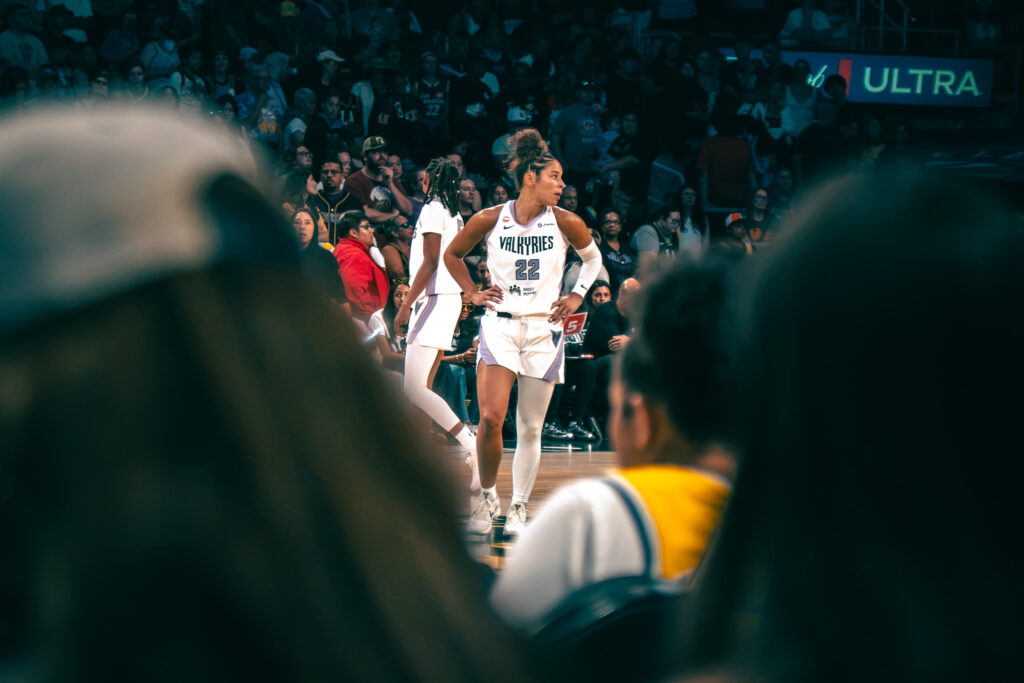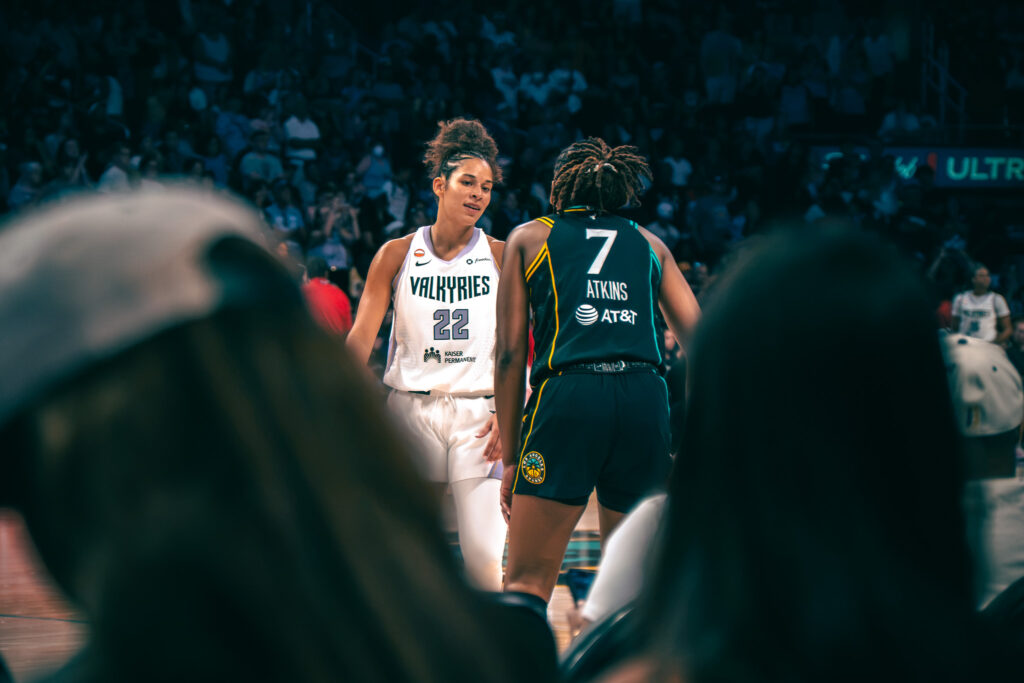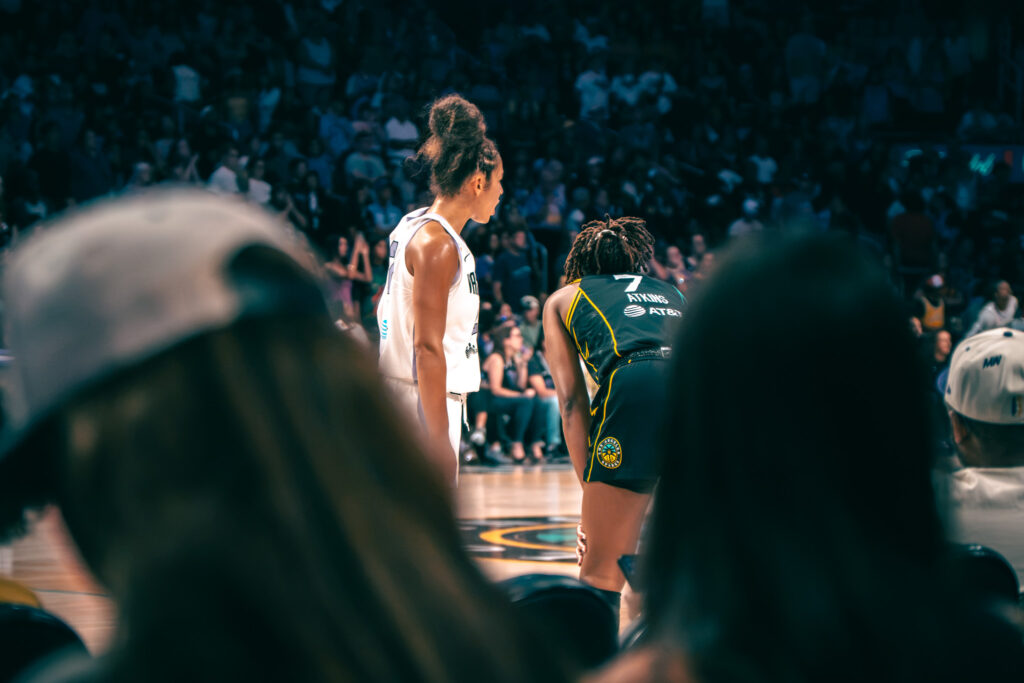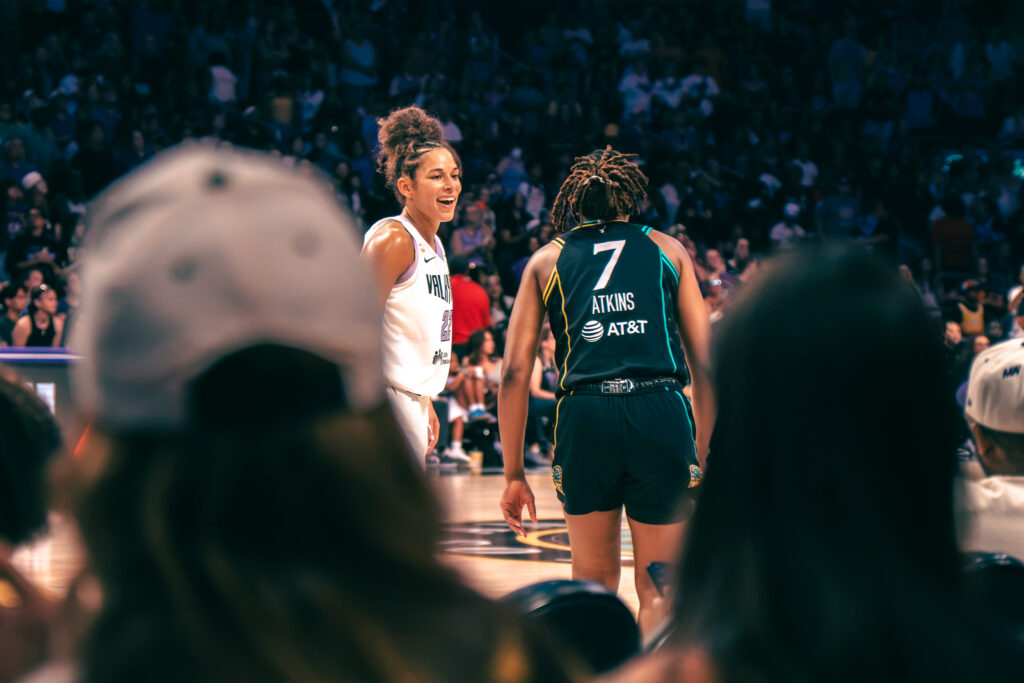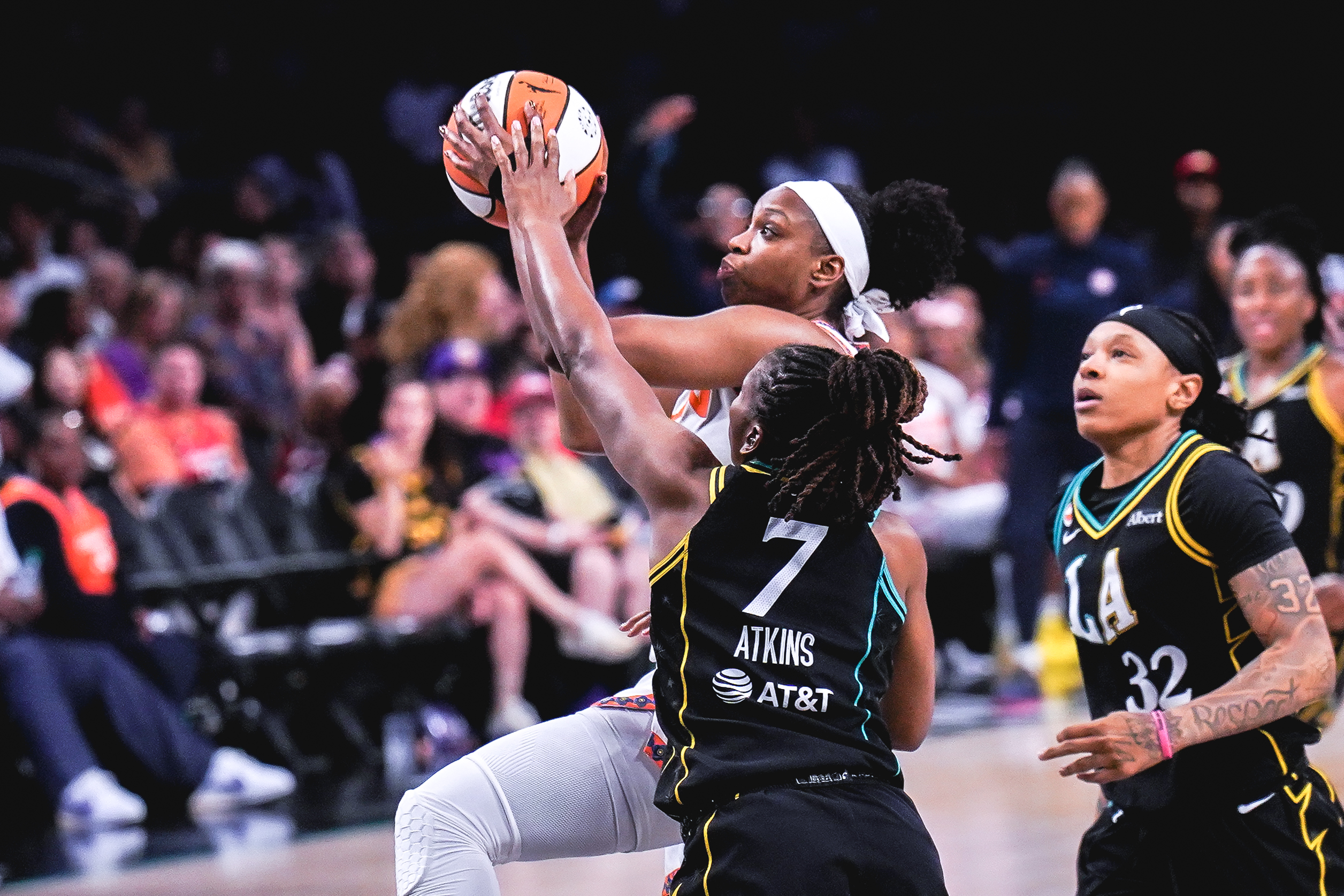
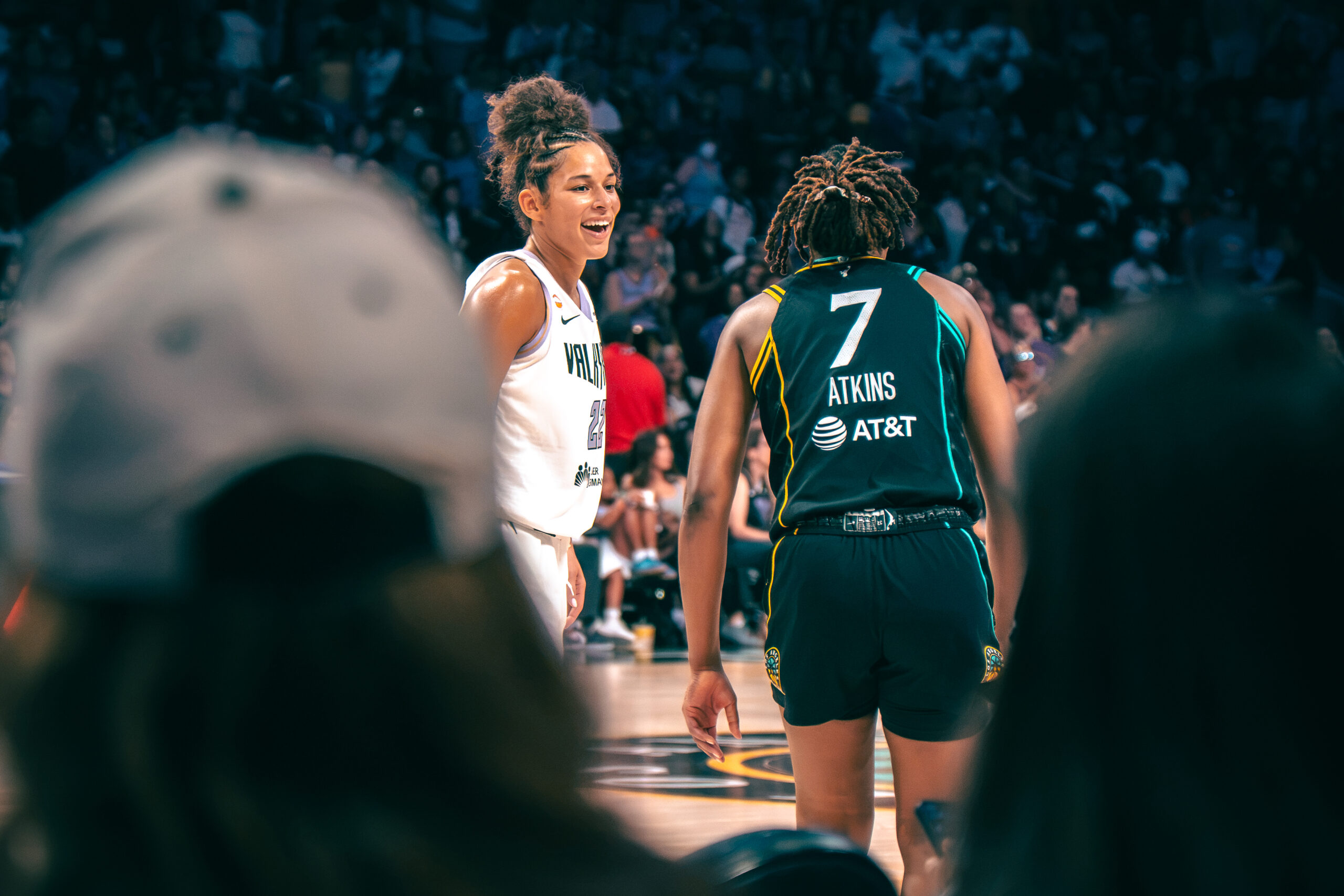
Veronica Burton (laughing) and Ariel Atkins prepare for one of the last possessions in the game, as the Sparks fell short of a come-back win at Crypto.com Arena Sunday night. (Laura Casadonte / Frame of Play)
The Sparks fought their way back. The Valkyries refused to unravel. From courtside, you could see both happening at once.
There are things about a basketball game that are much easier to notice when you’re standing close enough to photograph them.
Not necessarily the things that decide who wins. Sometimes it’s the way someone walks back to the bench after a timeout. Who talks after a mistake. How quickly a team resets after giving up a basket. Or what a player’s face looks like when the scoreboard says the situation should feel considerably more stressful than she appears to find it.
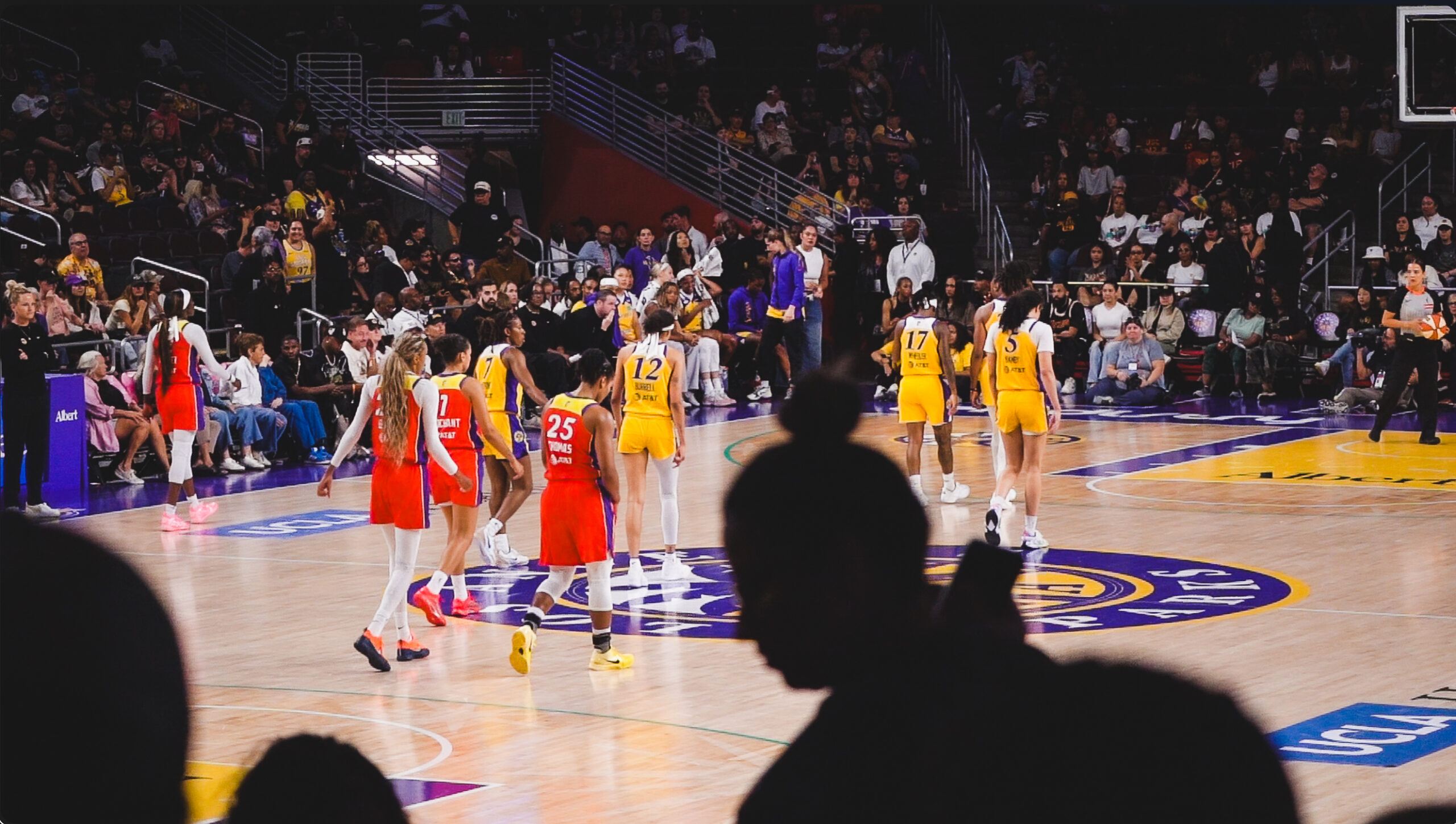
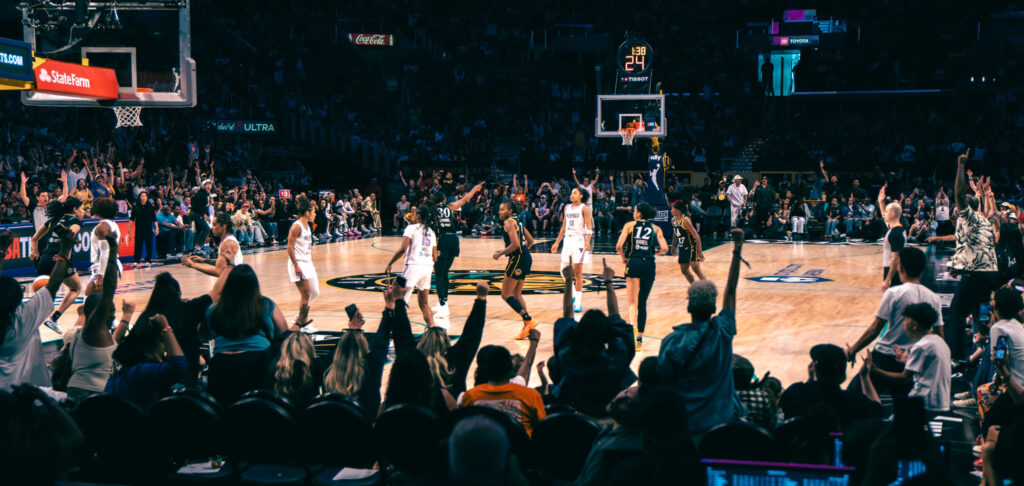
Sunday’s game between the Sparks and Valkyries gave me plenty of basketball to photograph. Golden State built a 19-point lead. Los Angeles spent the second half dismantling it. By the final minutes, the crowd was roaring, the lead had nearly disappeared, and what once looked relatively comfortable had become a one-possession game. I actually didn’t even notice how close the game had become until the crowd sounded extra loud and I could feel the energy had shifted. I looked at the score and thought ‘oh dang! When did that happen??’ Talk about a momentum report.
But what interested me most wasn’t simply that the Sparks came back or that the Valkyries eventually won 84–78.
It was how different the two teams looked while it was happening.
The Sparks looked like a team fighting to change the game.
The Valkyries looked like a team refusing to let the game change them.
And standing along the baseline trying to photograph both, I could feel that difference.
You could feel the Sparks changing the game
A 19-point deficit can make the rest of a game feel procedural.
Especially this late in the season, and especially for a Sparks team whose organization has increasingly turned its attention toward the future.
The players didn’t seem particularly interested in treating it that way.
As the deficit shrank, the game physically changed around them.
The reactions got bigger. The crowd got louder. Stops felt heavier. Each basket seemed to pull a little more energy into the building.
From where I was standing, that created its own challenge.
When a game gets tight, I’m trying to anticipate what’s about to matter. Where is the next play going to happen? Which end should I be on? Who might have the reaction I’m going to want if something happens?
By the final minutes, the energy was palatable, and I was feeling the nervousness in my own way too.
This game that had once looked fairly straightforward suddenly felt like it could produce the moment at any second.
And Los Angeles had created that feeling.
That’s worth noticing considering the larger circumstances around this team.
Organizations can make decisions with next season in mind. Front offices can think about roster construction, draft position and the future, but players don’t experience a basketball game that way.
There isn’t much room for organizational strategy when you’re chasing a loose ball or trying to get one more stop. Once a 19-point deficit becomes 10, and 10 becomes five, and five becomes one, the only relevant question is whether the game in front of you can still be won.
The Sparks played like the answer was yes.
And somehow, Veronica Burton was laughing
Which is why one of my favorite photographs from the game isn’t of a basket at all.
There were less than a couple minutes remaining. The game was tight. The building was loud. I was trying to figure out where I needed to stand in case something crazy happened. I’ve been doing this job a while, I’m not a player and have no effect on the game itself, but even I still feel the challenge of staying calm when the game is on the line. Which is why I found the next moment so interesting.
Veronica Burton and Ariel Atkins were already waiting at the opposite end of the floor before the ball had even been inbounded.
Atkins said something.
Burton laughed.
I have no idea what was said. Maybe they’re friends. Maybe it was an inside joke. Maybe it was something completely insignificant.
That’s actually not the important part.
The important part is what was happening everywhere else when it happened. Because I was standing outside the game feeling nervous about photographing its ending. Burton was responsible for actually playing in it.
And she looked like she was just about to play ball on the playground. Honestly it would have been more fitting of our emotional states were switched!
A photograph can’t tell us that Burton wasn’t nervous. It can’t tell us what she was thinking, and one expression shouldn’t be turned into a psychological diagnosis.
But it can show us behavior.
And in an environment that had become increasingly frantic, Burton was still comfortable enough to engage with an opponent, laugh at whatever she’d said, and then return her attention to basketball.
Once I noticed that, it became harder not to see the larger contrast.
Los Angeles needed urgency.
Golden State needed calm.
Composure isn’t the absence of pressure
The Valkyries hadn’t played a particularly composed game.
They’d allowed a 19-point advantage to become a one-possession contest. The Sparks were getting stops. The crowd had become a factor. Every Golden State mistake suddenly seemed capable of becoming part of the comeback.
That’s precisely what makes the response interesting.
Composure isn’t particularly impressive when nothing is going wrong.
It’s useful when everything suddenly is.
A disappearing lead can make teams start responding to what just happened instead of what is happening now. One turnover influences the next possession. A missed shot creates hesitation on the next one. The crowd gets louder, players speed up and suddenly a team isn’t only playing its opponent anymore.
It’s playing the momentum of the game.
Golden State never completely stopped Los Angeles from creating that momentum.
It just never allowed the momentum to finish the job.
Eventually the Valkyries made the plays they needed to make and escaped with an 84–78 win.
Two teams responding to the same pressure
That’s what stayed with me afterward.
The Sparks and Valkyries weren’t really displaying opposite qualities. They were showing two different responses to the same changing game.
Los Angeles needed to believe the circumstances could change.
Golden State needed to believe they didn’t have to change with them.
Fight is refusing to accept what the game currently looks like. Composure is refusing to let what the game currently looks like change you.
For several minutes, both worked.
That’s why a 19-point deficit became a one-possession game. It’s why the building sounded completely different by the end than it had earlier. And it’s why, despite all of that, Golden State still walked away with the win.
A box score can tell you the Valkyries beat the Sparks 84–78. It can show you the runs that created the comeback and the possessions that finally stopped it. But standing there watching the people inside those numbers, the game felt like something else too.
On one side, a team whose season could have given it plenty of reasons to accept a 19-point deficit refused to.
On the other, a team whose 19-point lead had almost completely disappeared refused to behave like everything was falling apart.
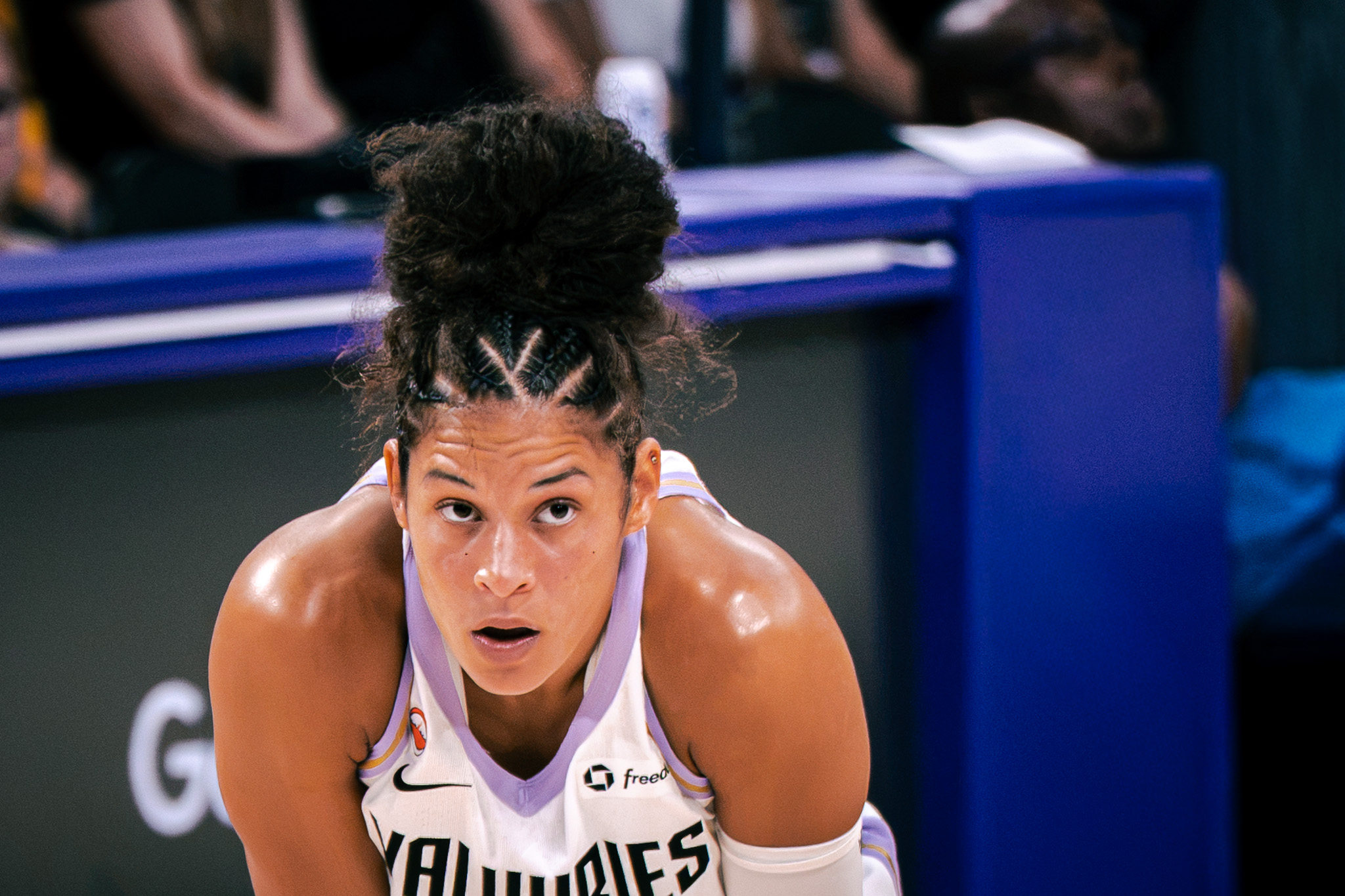
And for one brief moment, with the crowd roaring and the game hanging somewhere in between those two things, I happened to point my camera toward Veronica Burton.
She was laughing.
This is why I love sports, and my job.