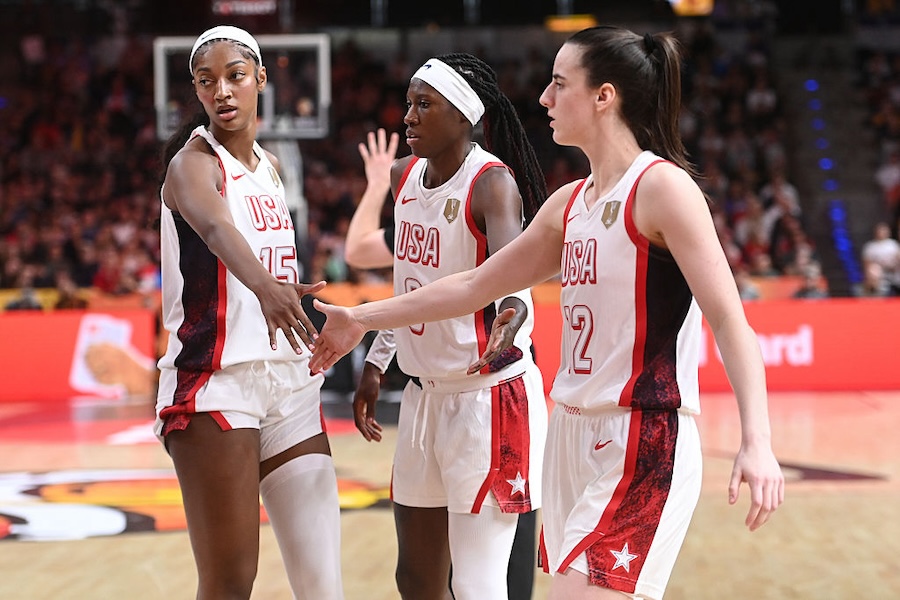
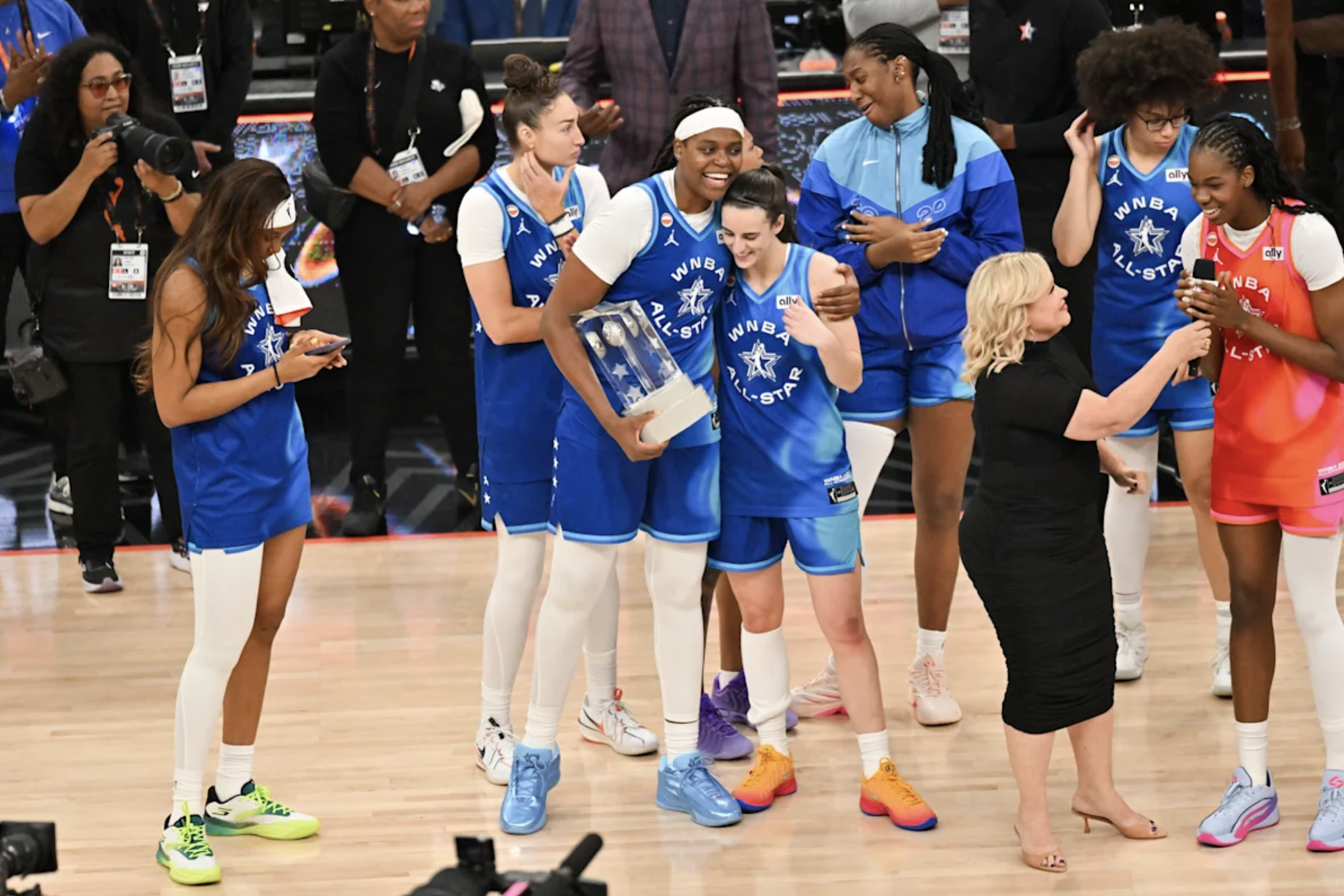
Team Spoon center Jonquel Jones (35) hugs guard Caitlin Clark (22) with the WNBA All-Star MVP trophy at the United Center. (Patrick Gorski-Imagn Images)
(IMAGN IMAGES via Reuters Connect / REUTERS)
A Look What All-Star Weekend Reveals That the Season Can’t.
“This is not All-Star Weekend. It’s StudBudz Weekend.”
That’s how Erica Wheeler put it in Chicago, and she wasn’t entirely joking.
A sponsored Twitch stream run by Natisha Hiedeman and Courtney Williams became one of the most talked-about parts of the WNBA’s biggest weekend. The setup was simple: two players, a hotel room, matching blue hair and a steady rotation of friends dropping by. There was no score to follow and no winner to crown. For hours at a time, people watched players talk, dance, joke around and simply enjoy being together.
It would be easy to treat StudBudz as a fun sideshow that happened to take off. But it was really just the loudest example of something happening everywhere you looked in Chicago, on the court, along the sidelines, during interviews and in the spaces between official events.
Showing us a version of players that the rest of the season simply does not have room for.
Start with the small moments, because they add up.
When A’ja Wilson was asked about her relationship with WNBA Commissioner Cathy Engelbert, she cracked, “My only relationship with Cathy is when she hands me awards, which is great. I love to see her.” It was only a few seconds, but it was a personality moment, and maybe a subtle dig at WNBA leadership, but that’s beside the point.
A wide range of questions were asked in the All-Star player press conferences, much wider than usual because there was room and desire to talk about and make content around these players as individuals.
But let’s not forget the 30th anniversary celebrations. So many former players were celebrated and attended the events. ESPN’s Holly Rowe could barely get through the introduction of these women before the game without getting a little choked up at what they meant to the game of basketball and to the WNBA.
Friday night’s Shooting Stars competition created a different kind of window. Legends, current players and rising talent shared the same court, with Elena Delle Donne competing alongside athletes from different generations of the game. They wanted to win, but the competition never seemed to overpower the pleasure of being there together.
During Saturday’s All-Star Game, there was still real gamesmanship. Players competed, (though some may argue the All-Star game should be little more competitive) but there was also a looseness that doesn’t happen in the regular season. Players who normally meet from opposite benches could enjoy sharing the same floor without a playoff race, a scouting report or a season series hanging over every interaction.
Then, after winning MVP, Jonquel Jones became emotional while dedicating the award to her aunt, who had recently died. The moment expanded the story beyond what she had accomplished on the court. It reminded everyone watching that athletes do not stop carrying grief, family and real life simply because a game begins, and that teammates who know them beyond basketball understand how to hold space for those things.
None of these moments were disconnected from the event. Together, they were the event.
What StudBudz Made Visible
StudBudz was simply the most literal version of that idea.
Hiedeman and Williams brought their livestream back for another All-Star Weekend, this time with AT&T sponsorship and blue hair to match. Players moved in and out of the room with little apparent concern for what the stream was supposed to become. Conversations wandered. People danced. Former teammates reunited. The appeal was not that something extraordinary was always happening. The appeal was that nothing needed to happen.
At one point, Napheesa Collier, Rachel Banham, Jessica Shepard and Bridget Carleton danced together. They are now scattered across different rosters, but for a few minutes, none of that seemed relevant.
Nobody needed to explain their history. Nobody needed to manufacture a reunion segment. They found each other because they wanted to, and the camera happened to be there.
That distinction matters.
The stream was sponsored, but it wasn’t last year and it still felt the same this year. It offered a kind of access that polished content often struggles to recreate: not access to a private revelation or a major announcement, but access to the ordinary chemistry between people who genuinely know one another.
Fans could watch relationships instead of merely being told those relationships existed.
It was a camera pointed somewhere cameras rarely stay pointed for very long.
The Moments That Weren’t Supposed to Be the Story
The interesting thing is that none of these moments were designed to become the defining stories of the weekend.
A’ja’s joke was not a marketing campaign.
The Shooting Stars event was not primarily presented as an intergenerational character study.
Jonquel Jones’ press conference was supposed to be about an MVP award.
Former teammates dancing in a hotel room was not part of the official schedule.
Yet these moments traveled across social media alongside the highlights and results.
That feels worth paying attention to.
During the regular season, nearly every camera pointed at an athlete is pointed at her competing. That is not a failure of sports coverage. It is the job. The game is the event, the matchup is the story and the broadcast follows the ball because that is where the action is.
But that structure has consequences.
For most of the year, fans see players primarily as opponents, scorers, defenders, All-Star candidates and names on a box score. Relationships become rivalries. Personalities are compressed into postgame answers. The people underneath the competition appear only in brief flashes before the camera returns to the possession.
All-Star Weekend loosens that structure.
The stakes fall just enough for other things to become visible. Players seek out former teammates. Veterans pull younger players into conversations. Rivals joke through interviews. Personalities that are usually guarded by the pressure of competition have more room to surface.
The players have not suddenly changed.
The frame around them has.
A Record Crowd Came for More Than a Game
That idea becomes even more interesting when you consider how many people showed up to experience it.
The 2026 WNBA All-Star Game drew 19,783 fans to the United Center, the largest attendance in the history of the event. That total also exceeded the announced attendance of 15,973 for the 2026 NBA All-Star Game at Intuit Dome. The venue capacities were different, so the comparison should not be treated as a perfect measurement of one league’s popularity against the other. But the milestone is still significant: for the first time, more people attended the WNBA’s All-Star Game than the NBA’s in the same year.
The easiest reading of that number is that the WNBA is continuing to grow. It is, and the record crowd offers another clear sign of that momentum.
But the weekend also suggests something more specific about what fans are responding to.
They did not show up only for an exhibition game. They showed up for an environment.
The game, the fashion, the personalities, the interviews, the fan events, the friendships and the spontaneous online moments all became part of the same experience. Even the people following from somewhere other than Chicago could move between the official broadcast and a hotel-room livestream and feel as though they were participating in one larger celebration of the league.
That is different from simply selling a basketball game.
It is creating a place where fans want to spend time with the league itself.
Competition may bring people into sports, but connection gives them reasons to stay. Fans want to admire what athletes can do, but they also want enough access to understand who they are, how they relate to each other and what kind of culture exists around the game.
StudBudz did not distract from the basketball. In its own strange, joyful way, it made the basketball mean more.
Once fans recognize the friendships, personalities and histories moving beneath the matchups, the next regular-season meeting carries another layer. The opponent on the other bench is no longer just an obstacle. She may also be a former teammate, an offseason training partner or the person who was dancing beside you in a hotel room two weeks earlier.
The competition remains real. It just stops being the only story.
What the Rest of the Season Leaves Out
That may be what is actually missing from the way players are covered during the other fifty weeks of the year.
The friendship and humor underneath the competition rarely receive the same amount of camera time as the competition itself. Fans usually encounter those qualities in fragments: a joke during an interview, a mic’d-up exchange, a player appearing in the background of someone else’s video or a brief interaction before tipoff.
Then All-Star Weekend puts all of those fragments in one place.
Suddenly, what usually feels like bonus material becomes the central experience. A livestream can be as compelling as an official event. A reaction can matter as much as the play that caused it. A reunion can become more memorable than the result of the competition happening around it.
It feels like discovering an entirely different league, even though these relationships were present all along.
Nobody was pointing a camera at them for long enough.
That is also why the attendance record belongs in this conversation. Nearly 20,000 people did not merely gather to evaluate an exhibition. They came to participate in a cultural moment surrounding a league whose players increasingly give fans reasons to feel personally connected to them.
The size of the crowd does not prove that every person entered the arena for the same reason. It does show that the weekend, as a whole, had become something people felt they needed to be part of.
The game was the centerpiece.
It was not the entire product.
A Different Kind of Access
Recognition does not come only from statistics, and it does not come only from a broadcast telling us someone is great.
It also comes from familiarity.
It comes from recognizing someone’s humor before she reaches the punchline. It comes from knowing which players gravitate toward one another. It comes from seeing who commands affection in a room, who makes everyone laugh and who quietly supports someone else during a difficult moment.
That kind of familiarity creates a different relationship between fans and athletes. It does not require viewers to believe they truly know a player’s private life. It simply allows them to see enough dimensions of a person that she no longer feels interchangeable with a stat line.
All-Star Weekend is one of the only windows all year where that access appears almost everywhere at once: a joke in an interview, a legend and a high school player on the same court, former teammates reunited in a hotel room, or an MVP allowing a joyful moment to hold grief at the same time.
For a few days, the cameras point somewhere other than the scoreboard.
The response suggests fans have been waiting for them to do exactly that.
The Frame
For most of the season, sports coverage is trying to answer one essential question:
Who won?
All-Star Weekend asks another:
Who are the best players in the WNBA when nobody needs them to be competitive with each other?
Judging by what fans watched, shared and showed up in record numbers to experience in Chicago, that may be one of the most valuable questions the league can answer.
The lesson is not that the competition matters less. The WNBA’s players are compelling because they are among the best basketball players in the world. But athletic excellence creates admiration, while personality, history and connection create emotional investment.
The game gives fans reasons to be impressed by athletes.
Weekends like this give them reasons to care and enjoy them.
That is what keeps bringing me back to StudBudz. On paper, a hotel-room livestream should not have been one of the defining stories of the WNBA’s biggest showcase. It was not a championship game, breaking news or even particularly polished television.
It was simply a camera placed inside the community rather than outside it.
And once it was there, people could not stop watching.
Maybe the cameras do not need to leave the court entirely.
Maybe they just need to look around it more often.