What’s ACTUALLY going on behind the scenes when you consume media on game days.
Did you know there’s mics on the basket to pick up the perfect swoosh? Did you know how many there are??
I came across a video recently from Dallas Taylor featuring Ben Majchrzak, a senior audio engineer at NBA on NBC, walking through exactly how a professional basketball broadcast gets wired mixed for sound. Mic placements, mixing decisions, the whole invisible infrastructure. As someone who has spent fifteen years on the production side of sports media, both live and post-produced, I can assure you that there’s way more going on during games than you think. And even when you’ve been in it, you can forget how much is actually happening.
So let’s talk about it. Because people are genuinely shocked when they find out.
Start with sound, because sound is actually where the story begins. There’s a principle in editing, used in sports and in your favorite movies or YouTube videos, that picture follows sound. When you hear something — a whistle, a crack of a bat, a crowd erupting — your brain already knows what happened before your eyes confirm it. Editors use this on purpose. The sound cut comes first, then the visual, because that’s how human perception actually works.
And that sound doesn’t just happen on the court or field and then magically you hear it. There’s a microphones EVERYWHERE. In football youve surely seen the people on the sideline carrying something that looks like a satellite dish. For basketball, their inside the basket to capture the swish. Contact microphones screwed into the underside of the floor panels to pick up every shoe squeak and body impact. Mics behind the backboard glass, mics next to the rim spring, a shotgun mic on the handheld camera to fill in the gaps. The game sounds natural because someone spent hours before tip-off making it sound that way in an empty arena. I’d suggest checking out Dallas’ video for a full rundown because, spoiler alert, I’m not an audio engineer…it makes my head spin.
But now, take the same level of detail and apply it to the picture.
Another term I’d like to introduce that you’ve probably never heard of is “Shade” – there is a person sitting at a monitor adjusting the camera exposure levels in real time as the sun moves, comes out from behind clouds, disappears again. It doesn’t sound like a big deal until you think about what happens when the quarterback is standing in full sun and throws a deep ball to a receiver standing in shadow. If nobody adjusts in the half second between the throw and the catch, the audience can’t see the play. Like literally can’t see it. That’s one person, watching the sky as much as the game, making a call that the audience will never know happened but will absolutely feel if it goes wrong. I’ve done this job a few times, and let’s say it isn’t for a space cadet (aka me most of the time).
And then there are the graphics. When an announcer mentions a stat and it appears on screen, it seems automatic: “of course it’s there on screen, the announcer just said it.” That’s what you think subconsciously while you watch the broadcast on your couch, but someone had to make those, queue them, and time it correctly. Several people, usually. Each one responsible for a layer of the broadcast that feels invisible until it isn’t.
And don’t even get me started on the live camera operators. Pro operators are certified BALLERS. Particularly in football, because they are partucalrly good at ball tracking, which can be incredibly hard in real time.
It depends on the sport, but there can be anywhere from about 5-20 people all on live cameras who are LOCKED IN for the entire duration on the game. I found when I worked live cameras sometimes I would forget to blink for significant periods of time.
Take these examples and multiply it by like 40 conservatively, because there’s probably at least that many people or jobs happening behind the scenes and impossible to go over quickly in this post.
And then there’s the post production, social media or ENG (Electronic News Gathering) side…the one I live in more these days.
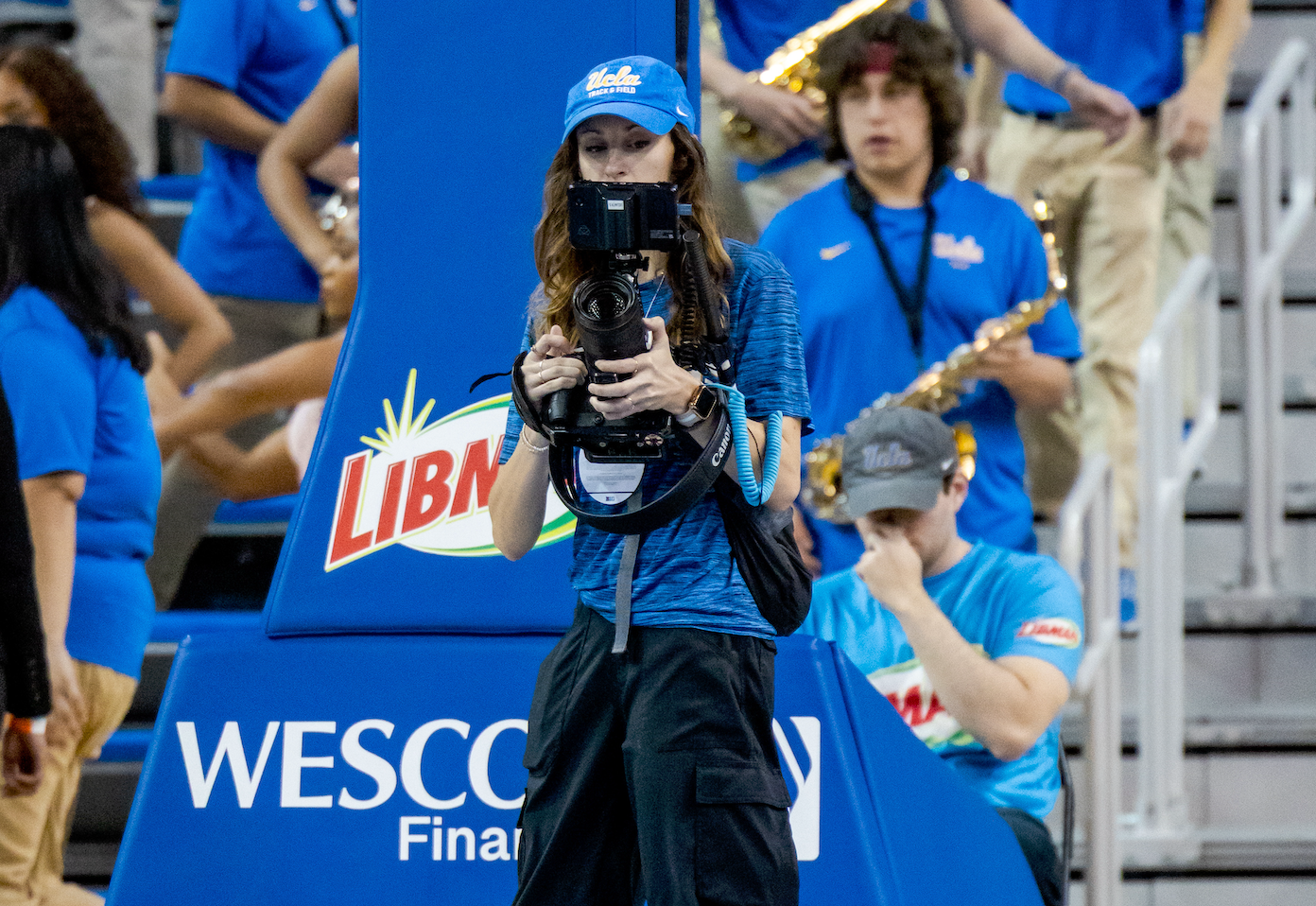
When I’m on the sideline shooting photos or video, sometimes I’m the entire production team. Shooting, editing, and sending content out in real time, all at once. If you are fortunate, you are one person in a small team of 2-10 doing that work, but not always.
If you’re on live photos, that means the second something big happens you’re plugging your memory card into your phone, editing fast, trying to get the shots out while simultaneously not missing whatever is currently happening during the game. Time moves differently in those moments. There is no slower feeling than waiting for a file to transfer when something is happening in front of you, and no faster feeling than realizing you have a few minutes to edit and send something before the moment is old news.
Nobody watching sees any of that. They just see the post on their timeline.
That’s true of almost everything in sports media. The swish sounds perfect because someone mic’d the rim. The graphic appears at exactly the right moment because someone was listening for the cue. The dark corner of the field is visible because someone was watching the clouds. The photo hits your timeline ten minutes after the final buzzer because someone was running (and probably sweaty).
The game is one thing. What you experience at home is something that a lot of people built for you, in real time, while you were watching.
Next time you go to a game in-person and see someone with a camera of credential, give ’em a ‘lil fist bump.