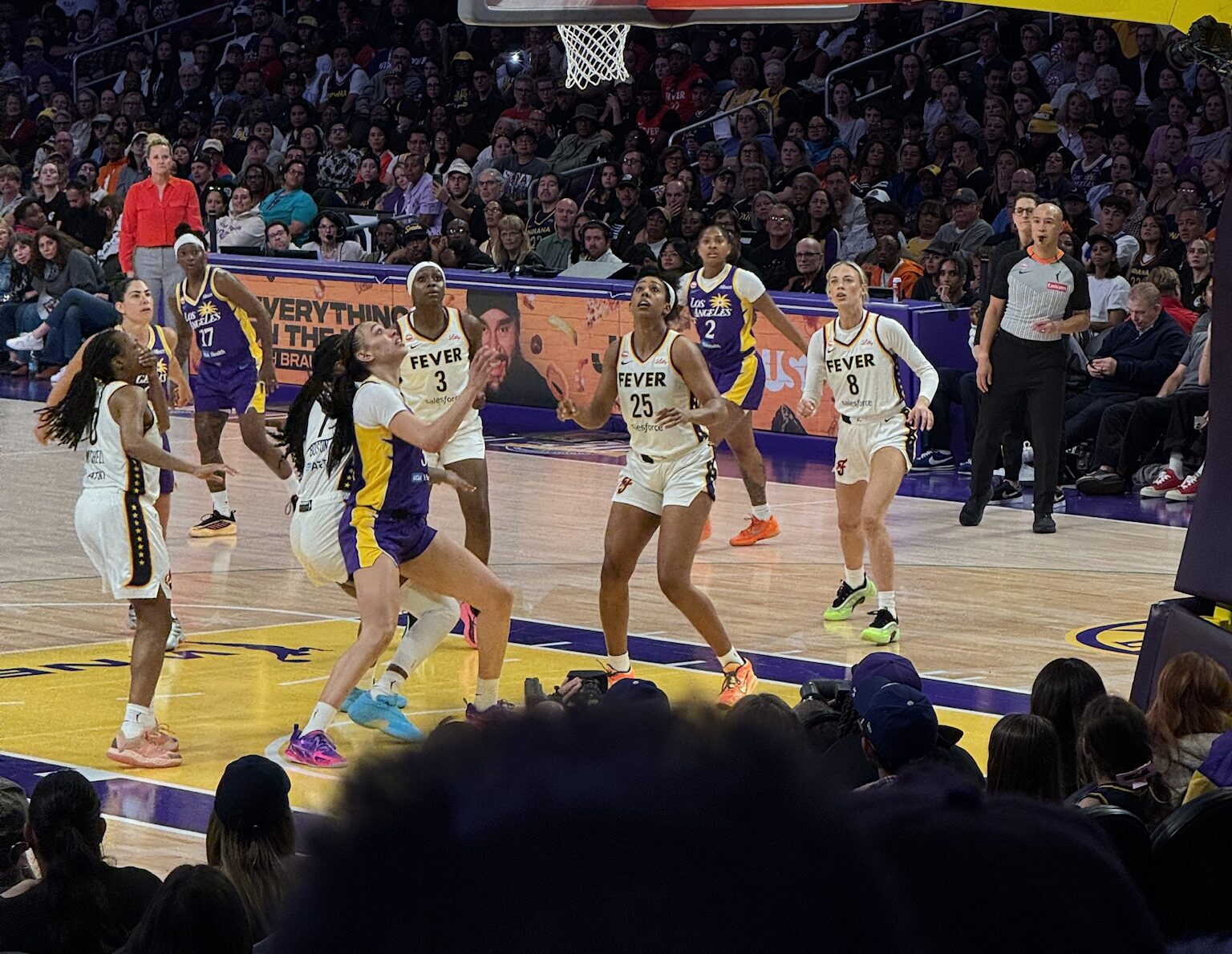
How we can look at recent events with the Indiana Fever as a case study for a greater issue with many modern sports fans.
After fifteen years behind a camera at countless games, you learn some things. One of those things seems to be something that most fans and most sports media has quietly forgotten: a moment is not a story. What surrounds the moment is the story.
I made Frame of Play because there’s real value in watching closely; the bench, the body language, the subtle signals that explain what’s happening before the scoreboard does. But there’s a version of that kind of watching that isn’t insight at all. It’s surveillance. And the Indiana Fever have spent most of this season as its primary subject.
New technology, social media, and more coverage in broadcasts have started to change the way people see and talk about sports, and generally it’s not in a positive way. Everyone thinks they’ve seen enough to be an expert on the situation and are in a position to pass judgement like it’s law. And somehow they feel like they are so close to players that they think they know them, yet are distance enough to forget that they are still just humans that have unique personalities and aren’t perfect all the time…just like anyone else.
These aforementioned trends along with the general feeling of hyper criticism becoming rampant is honestly quite exhausting, as both a consumer of sports media as well as someone close to the action. Some recent news surrounding the Indiana Fever is a good case study for examining some of the greater issues across the sports world.
In late May, the Fever lost badly to the Portland Fire. They were down 20 points. Caitlin Clark was not having a great night. During a timeout, coach Stephanie White addressed her directly, animated, pointed, clearly challenging her player in the middle of a difficult situation, and Caitlin was also animated in return. A fan in the stands caught it on video. By the next morning it was everywhere.
The coverage treated it as evidence. Evidence of tension, of dysfunction, of a relationship fracturing under pressure. Days of analysis and conspiracy theories about leadership failures and locker room problems followed.
Clark’s response when asked what the dispute during timeout was about: “We were down 20 points, so. Probably that.”
That’s the whole thing. A coach coaching. A player being coached. Two competitive people in the middle of a hard game doing exactly what competitive people do in hard games. The camera caught a moment and the internet decided it meant something. But without the score, the context, the relationship between these two people, and the basic understanding that this happens in timeouts of many games in every sport, the moment is just pixels. White put it plainly: “What happened in that moment is, I was challenging a player. It’s coaching, is what it is. I don’t often think it becomes an issue if you’re watching it in men’s sports, most of the time.”
In a separate interview conversation Caitlin herself said something that should have ended the all the chatter entirely, but unsurprisingly this comment didn’t go viral: “When I got hurt at the Connecticut game last year, I bawled in Steph’s arms. That’s somebody I will ride for for the rest of my life. People that just sit on their phones all day, they don’t see those moments.”
That’s the thing. They don’t see those moments. Nobody does. Except the people in the room.
A camera catches a timeout. It doesn’t catch the conversation that happened before tip-off, or the text sent after the game, or the moment a coach holds a player while she cries over an injury that takes her season away. Unseen moments like that are so powerful. They are almost certainly more defining of a relationship than any sideline exchange caught on a video taken from the upper deck. But they don’t go viral. They don’t get screenshotted. They don’t generate clicks.
This is what it means to watch with grace; not to ignore what you see, but to hold it lightly. To ask what you don’t know before deciding what something means. To understand that you are watching a fraction of a relationship, a fragment of a game, a sliver of a season, and that the parts you can’t see are often more real than the parts you can.
Here’s what to actually watch for instead:
-When you see a heated sideline exchange, ask what the score. A coach getting animated when their team is down 20 is not the same as a coach getting animated when thier team is up 10. The emotional register of competition is entirely dependent on context and a clip without context is not information.
-Separate the moment from the person. A frustrated expression in the heat of a hard game is not a character assessment. It’s a person competing
-Learn the more about the sport you’re watching. You don’t need to be an expert but understanding what is normal or what a play is supposed to do helps you recognize when something goes wrong and why a player or coach might be frustrated.
-Give things time to develop. A team losing four games in a row is not a broken team. A player having a bad week is not a player in crisis. Sports move in cycles and patterns that only reveal themselves over time.
Watching closely is only valuable if you know what you’re looking at. And knowing what you’re looking at means accepting that you’re only ever seeing part of it.
As a viewer, take beat, take a step back, and remember that sports are supposed to be fun! Being invested is great and part of that fun, but also at the end of the day, it’s a game. Athletes are already under enough pressure as it is, and having fear of an invisible mob breathing down their necks and scrutinizing their every move does not help them, nor does it make for a good product for fans. Also since we were already talking about the Fever, let’s also remember to give Caitlin, specifically, some space and grace.
Watch with context. Watch with patience. Watch with the understanding that these are people doing an extraordinarily difficult thing under enormous scrutiny, and that a single frame without everything that surrounds it, tells you almost nothing at all.
The moments that matter most are often the ones nobody films.