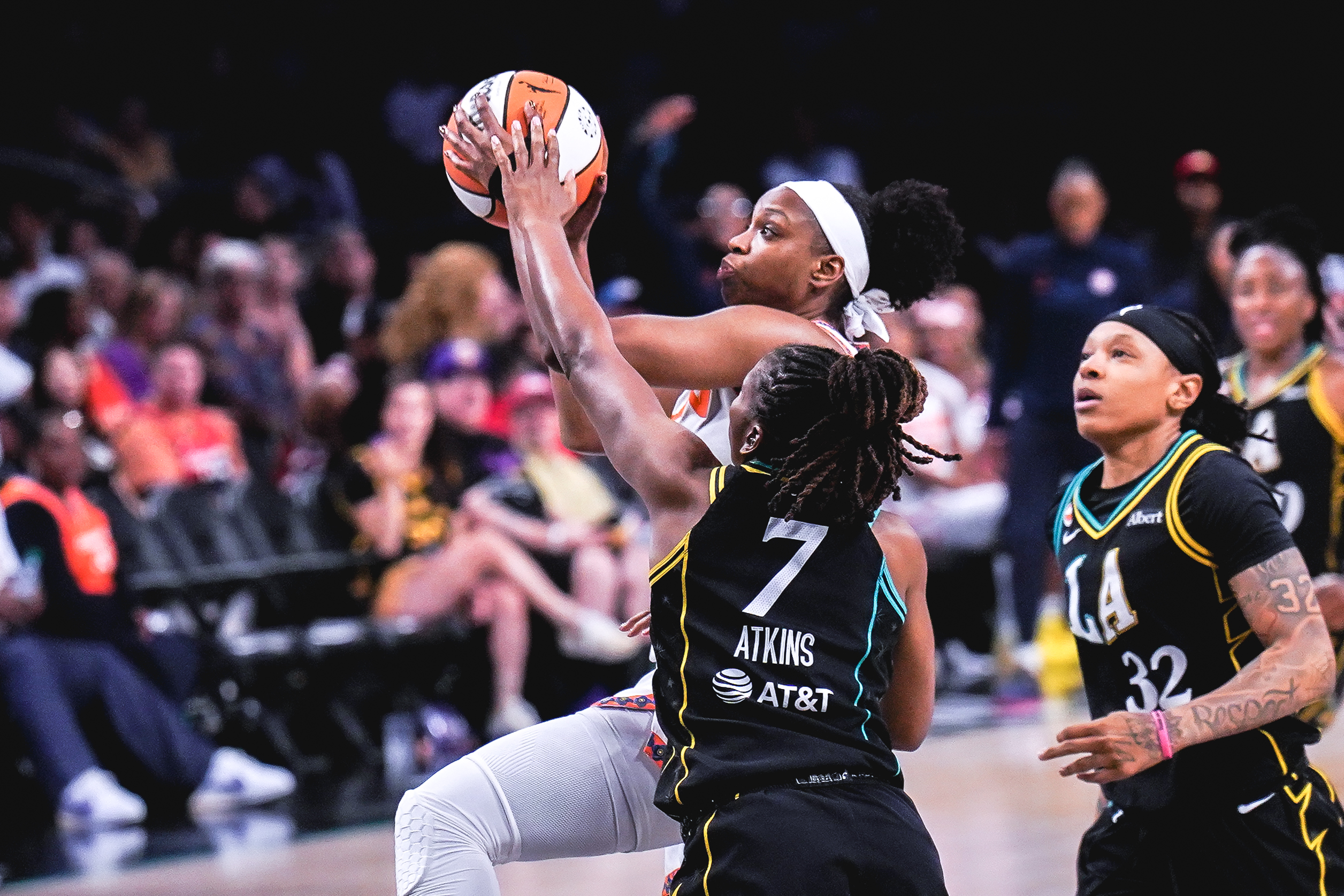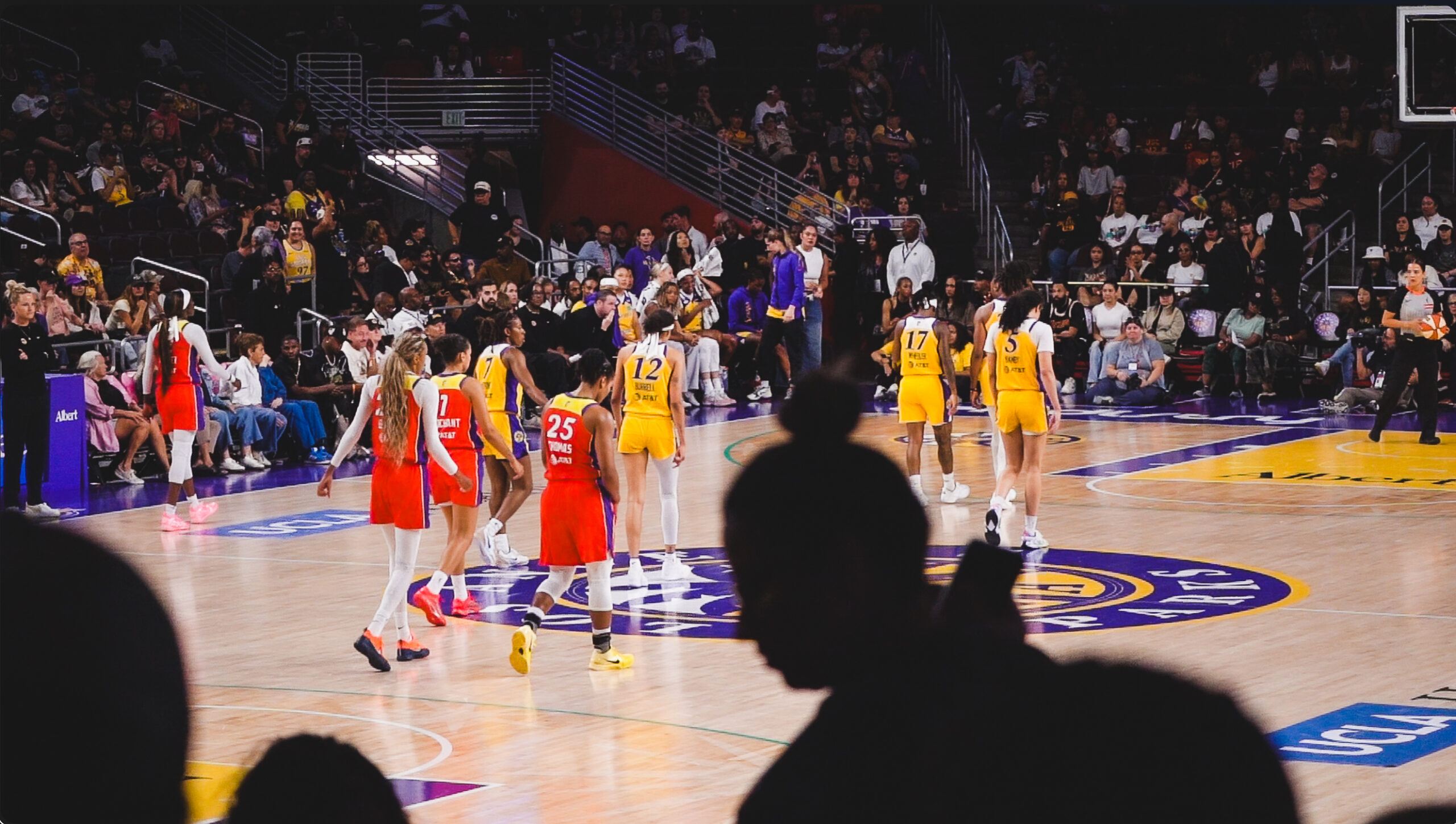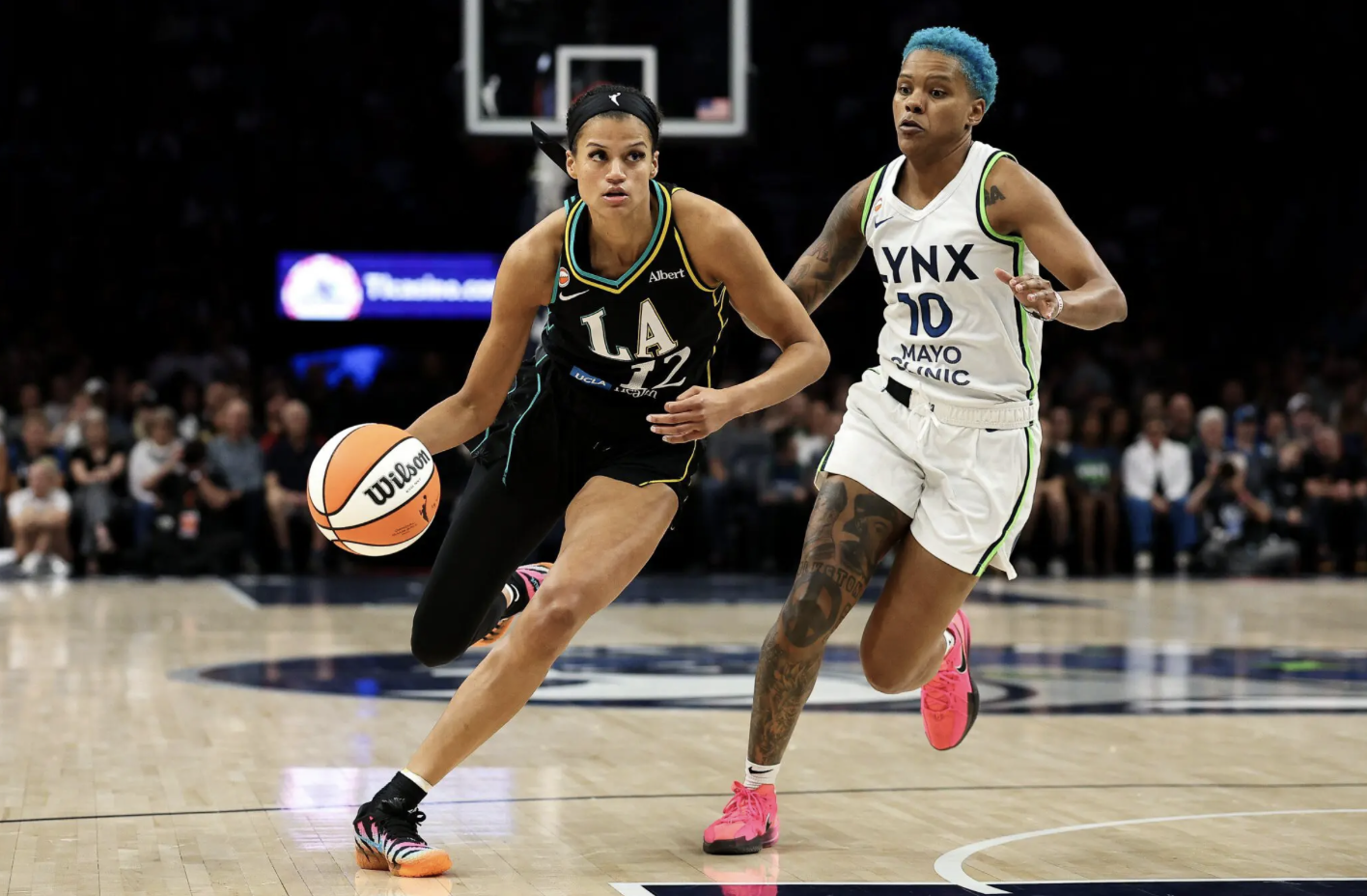
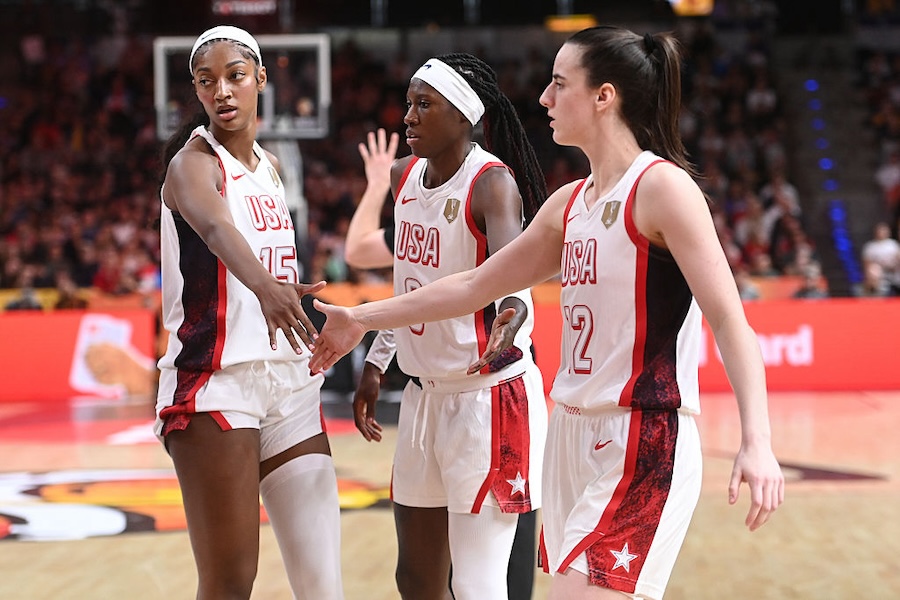
Angel Reese, Rhyne Howard, and Caitlin Clark and Team USA Basketball won vs China in this morning’s FIBA World Cup win. (Juan Ocampo/NBAE via Getty Images)
China gave the Americans problems their WNBA stars rarely encounter, but the way Team USA solved them was more interesting than the 94–61 final score…and their biggest asset may not be what you thought.
A 33-point win doesn’t usually scream that a game was a problem-solving exercise, but it wasn’t all smooth sailing.
Team USA opened its FIBA Women’s Basketball World Cup with a 94–61 win over China, all 12 American players scored, four finished in double figures, and by the fourth quarter the game looked about how you would expect a roster this talented playing together to look.
But there were stretches when it didn’t, and those stretches may have told us more about this version of Team USA than the final score did.
China presented the Americans with two problems that are particularly interesting for this roster: size the U.S. can’t match and a defensive structure most of its players rarely see in the WNBA. For a while, both worked.
The WNBA’s defensive three-second rule prevents a defender from simply camping in the paint without actively guarding an opponent. FIBA has no such restriction. Against China, that distinction becomes especially noticeable when the person waiting for you at the rim is 7-foot-3 Zhang Ziyu.
Team USA could get downhill. Getting somewhere useful once it did was another question.
During one second-quarter stretch, the Americans repeatedly tried to penetrate off the dribble only to find China still waiting in the middle. The offense stalled, the U.S. went several minutes without scoring, and China put together a 9–0 run.
For the first time in the tournament, Team USA had a puzzle to solve.
The answer wasn’t to try harder to do the same thing. It was to change the geometry of the game.
Fine. Make Them Guard This!
There is a tried and true principle for attacking or breaking a zone: ball movement with passes. Even in my days of playing basketball myself I distinctly remember this because it was so effective. And also nothing makes you want to play hot potato with the ball more than seeing two players come screaming at you for a trap.
Conveniently, passing happens to be one of Caitlin Clark’s specialties.
There will inevitably be plenty written about Clark after this game. She finished with 14 points and 11 assists, earned Player of the Game honors and recorded the most assists by an American in a Women’s World Cup game since Dawn Staley had 12 in 1998. However, her importance against China wasn’t interesting simply because Caitlin Clark had another good basketball game.
It was interesting because the things Clark does unusually well were unusually useful against what China was trying to do.
Pack the paint?
Fine. Pass around it.
Don’t want to bring the defense far away from the basket?
Fine. Clark can shoot from several feet beyond where you want to defend.
Want to put enormous players around the rim?
Fine.
Make them run.
Clark is one of the best passers in basketball (along either Chelsea Gray), but it’s not simply that she can make difficult passes. She is constantly looking for them. She wants the ball moving, wants the defense shifting and wants the next advantage created before the current one disappears.
That tendency matters against a zone.
So does her range. A defense designed to protect the paint becomes considerably less comfortable when someone is willing to shoot from well beyond the area it wants to cover.
And then there is pace.
Clark wants to play fast. So does her Indiana Fever teammate already accustomed to running with her.
On one sequence, Aliyah Boston took off toward the other end and Clark found her quickly in transition. Suddenly, China’s extraordinary size advantage had become considerably less useful.
A 7-foot-3 center is a terrifying problem if the game is being played vertically around the basket. She’s a different kind of problem if you’re asking her to play 94 feet horizontally.
That distinction became part of Team USA’s solution. Take a look at Caitlin’s highlight to see for yourself:
https://www.instagram.com/p/Dc3msJ5jHFQ/?img_index=1
The front court was also fighting for their lives under the basket.
Of course, someone still had to deal with China’s size when the game was being played around the basket.
There were possessions where watching the 6-foot-5 Boston establish position against the 7-foot-3 Zhang looked less like a box-out and more like someone had assigned her a physics problem. As candidly noted by her podcast mate Candice Parker:
Then China could add 6-foot-10 Han Xu to the equation.
This was one of the biggest questions surrounding this American roster before it ever arrived at the World Cup.
Team USA is not particularly big by international standards, and A’ja Wilson’s absence removes a player whose ability to control space around the basket routinely makes her play even bigger than her listed height.
China was about as extreme a test of that weakness as the Americans could get. The mismatch was clear, and sometimes a little frustrating, and yet the mismatch never became the defining feature of the game. When the frustration became more problematic, the solution was making size less valuable.
That might matter considerably more as this tournament continues.
There Was Always Another Answer
Rhyne Howard provided one of the first.
When the offense needed separation in the first half, Howard’s shooting gave it some. She scored 11 of her 14 points before halftime, knocking down timely threes that helped keep China from turning its better stretches into something more threatening.
Then the offense changed again.
Clark increasingly became a facilitator. The ball started moving more freely. Transition opportunities appeared. The floor opened.
And in the second half, Paige Bueckers arrived.
Bueckers scored all 14 of her points after halftime, including a strong fourth quarter, giving Team USA yet another source of offense after Howard had carried much of the early scoring load.
By the end, four Americans had reached double figures: Howard, Clark and Bueckers with 14 each, and Jackie Young with 12.
More importantly, every player who stepped on the floor scored. That statistic says something beyond depth.
Howard can shoot a team out of a difficult stretch. Clark can manipulate its defensive structure. Bueckers can find openings once the floor changes. Boston can absorb an absurd physical assignment underneath. The guards can pressure the point of attack. Another lineup can push the pace.
Every player on this roster can do many of those things. That’s part of why they’re here.
But their specialties aren’t identical.
And that may be the point.
The Most Useful Weapon Isn’t One Player
It’s tempting with a roster this talented to view Team USA’s biggest advantage as simply having more great players than everybody else.
That’s true, but it’s also not particularly interesting.
What China exposed for a few stretches was that talent doesn’t automatically make every basketball problem disappear. Team USA had to adjust, the paint frequently wasn’t open and the Americans couldn’t simply dribble their way into it.
China had a player nearly a foot taller than some of the people tasked with keeping her away from the basket.
The rhythm wasn’t immediately there, either. This is still a collection of players accustomed to being central pieces of different teams learning how to operate together under different rules against international opponents who present different problems.
And then something started to click.
Howard stretched the floor. Clark moved the defense. Boston and Reese fought underneath. The Americans sped the game up. Bueckers took advantage as the floor opened. The defense created transition opportunities. The ball started flying around.
Eventually, everybody ate. That’s what made the first World Cup game encouraging! Not that Team USA won by 33, it was supposed to be good enough to beat China.
The more interesting question was what this particular collection of players would do when its normal advantages weren’t immediately the answer.
For at least one game, we got an answer.
China said: We’re enormous.
Okay. Run.
China said: We’re packing the paint.
Okay. Pass.
China said: We’re not coming out there.
Okay. Shoot.
And once all of that pulled the floor apart, Team USA could go back to looking like Team USA.
The Americans’ most useful weapon at this World Cup is their adaptability through their diversity.
Having enough different kinds of great players that, whatever problem an opponent creates, someone is unusually well equipped to solve it is going to be their main advantage.
China giving them a few problems worth solving in Game 1 was very helpful as everyone gets their jitters out and has their first game together. The group stage will be a great chance to iron out a lot of the wrinkles that could give them trouble latter on, so we will see what challenges the Italian squad brings for the US’ next game on Sunday!