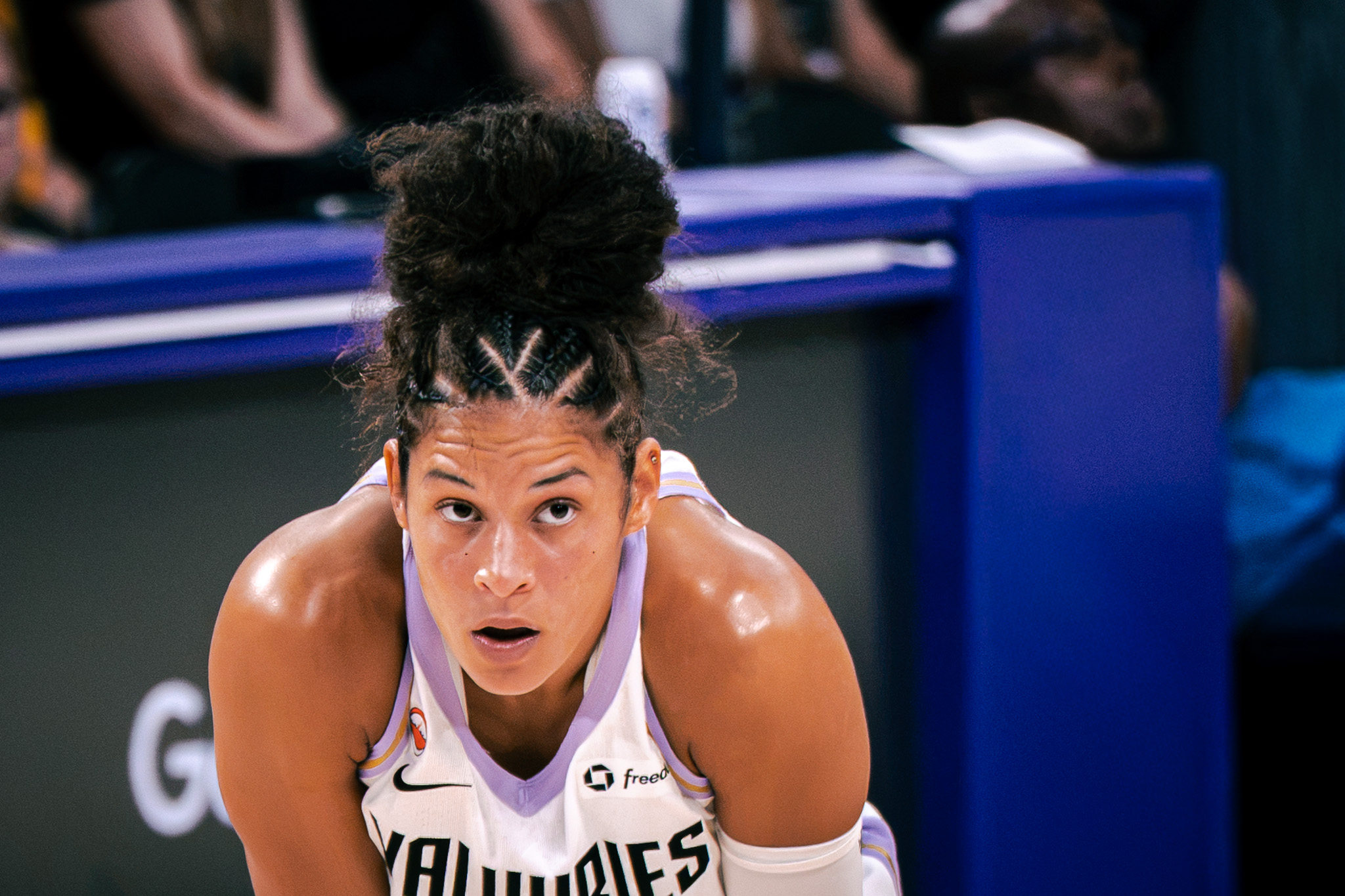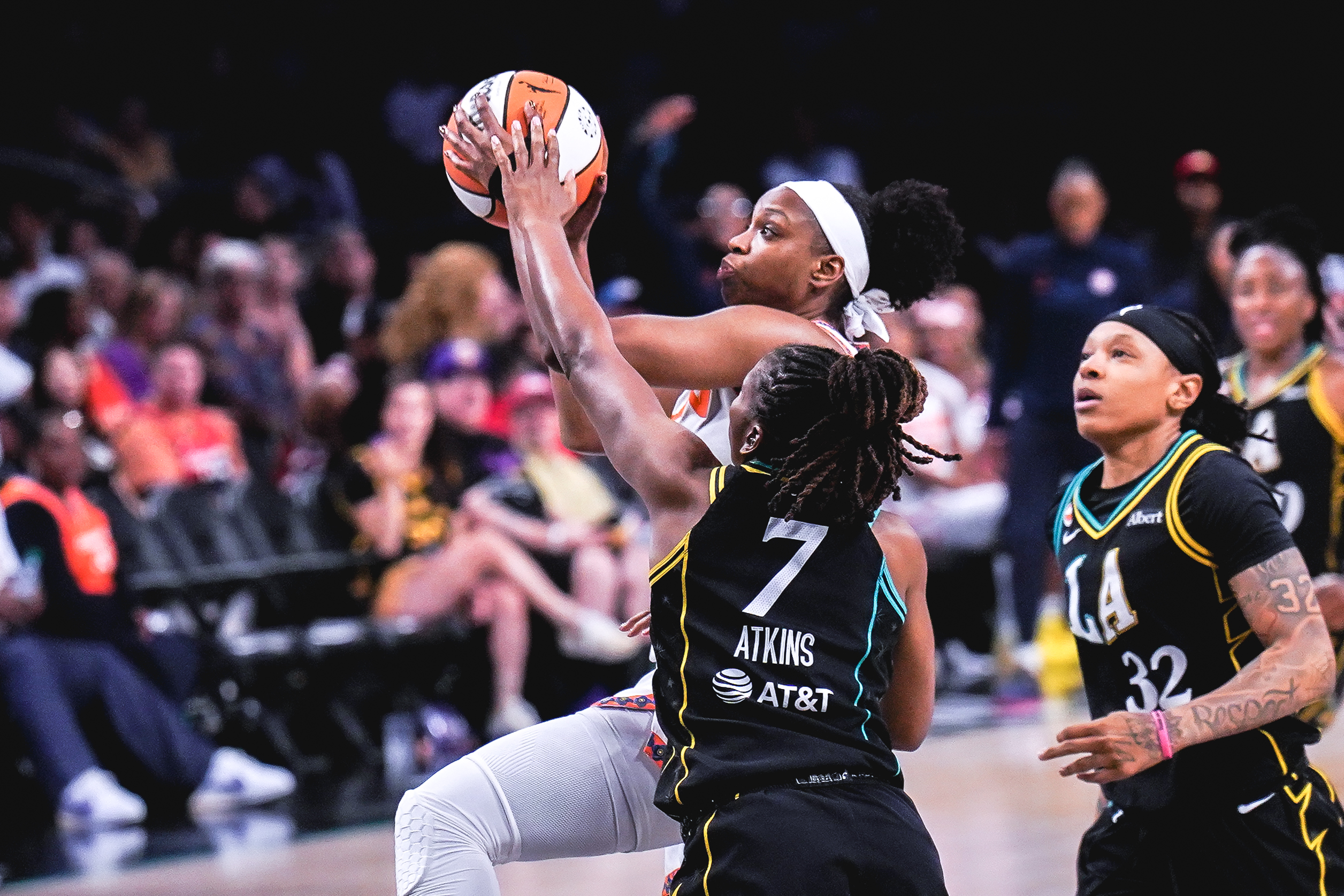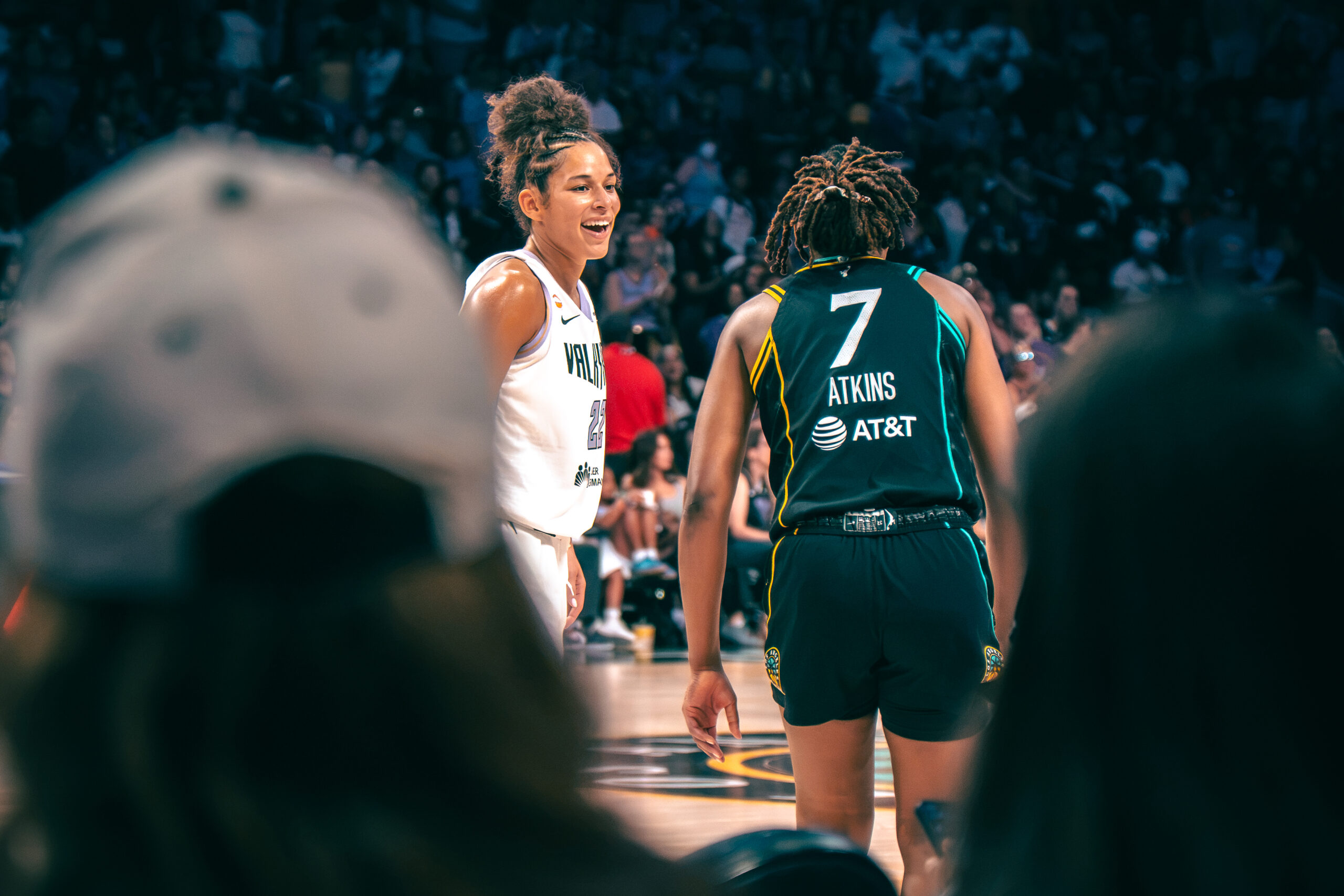
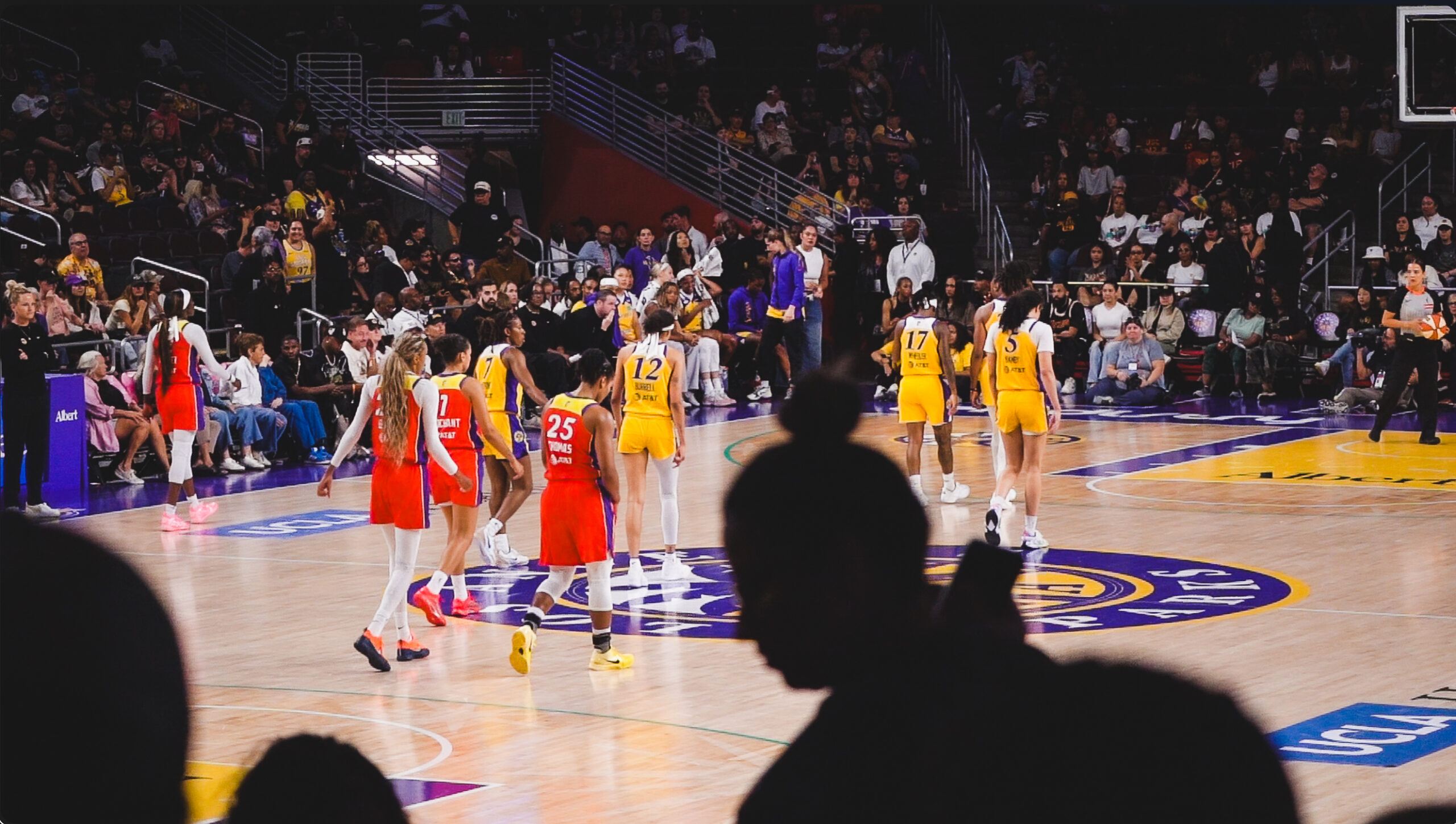
Fans start to file out of the Galen Center as the players walk to the foul line in the final seconds of the La Sparks’ loss to the Phoenix Mercury. (Laura Casadonte/Frame of Play)
When winning is no longer a reason to stay, staying can matter most.
The game was down to the wire, a back and forth battle between Phoenix and LA Tuesday night. Then the dagger came from the Mercury and LA fouled to stop the clock with seconds left when people started heading for the exits. The game wasn’t technically over, but everyone knew where it was headed.
From where I was positioned in the stands with my camera, people started getting up in front of me, and I looked around the arena as people start filing out.
Then I looked back at the court. The players were still at the free-throw line. They were still playing.
It was a small, ordinary moment that happens at sporting events all the time, but it’s till tough to see sometimes, and it really stuck with me this time for some reason.
Because when winning is no longer the reason to stay, I think that’s when staying can mean the most.
It’s easy to support a team when they’re winning. Winning gives you something back. It’s exciting. It’s fun. You get to celebrate and feel, in some small way, like you were part of it.
Losing asks something different of a fan. It asks you to support people when there may be less coming back in return.
We don’t know whether any of the Sparks noticed people leaving that night. I don’t know what Rae Burrell was looking at when I photographed her glancing toward the stands as she walked down the floor. But I’ve spent enough time around teams that are struggling to know that the relationship between the people in the stands and the people on the court isn’t as one-sided as it sometimes feels.

Fans notice everything players do.
Players sometimes notice back, too.
The two sides of the same coin…
In 2022, before Deion Sanders arrived, I was shooting a Colorado football game for Pac-12 Networks during a season the Buffaloes would eventually finish 1–11.
At one point during that game, I was positioned near the student section behind the Colorado bench.
A young fan started yelling something toward one of the players. I don’t remember exactly what he said, but I remember that the player heard it. He turned around and responded in frustration while he was sitting on the bench.
I remember thinking how miserable that must have been. You’re already losing. You’re living through a season in which almost nothing has gone right. And now someone sitting behind your own bench, someone ostensibly there to support your team, is adding something else to carry.
Later at the end of that same game, I saw the exact opposite.
A group of fans that lined the stands surrounding the tunnel back to the locker room were cheering as the players walked to the locker room. They were telling the players to keep going. That they were close. That they’d get one. That they should keep working.
I remember the players walking toward the tunnel looking exhausted and defeated.
Those fans couldn’t change that. They couldn’t change the score they had just watched. They couldn’t fix Colorado’s season. They couldn’t turn a team headed toward 1–11 into a winner.
But they could decide what they added to an already difficult moment. Even though they didn’t really show it, surely the players felt some encouragement from their support, but at least it was net neutral at worst.
There are moments when someone is struggling and you don’t have the right words. You can’t solve what’s happening. You don’t know how to make it better. Sometimes all you can do is be there. You don’t have to stand beside the tunnel giving a speech. You don’t have to yell. You don’t have to pretend you’re happy about losing, and you certainly don’t have to stop being frustrated when your team plays badly.
Maybe you don’t say anything at all.
Your presence says something on its own.
Losing is when support gets complicated.
I experienced another version of this at Baylor.
My freshman year was an almost absurd introduction to college football. Baylor spent much of the season undefeated and ranked No. 2 in the country. The stadium was packed. The atmosphere was unlike anything I’d experienced before.
Then everything changed.
By my junior year, after two seasons of turmoil around the program, I was living with current freshmen who had never known Baylor football as anything other than what it was then.
Before one game, I asked one of my roommates if she was going. I had to work the game, but I thought she and our other roommates might go together.
“I don’t know, what’s the point? We’re not even good anyway.”
I remember how immediately that bothered me.
I had seen what Baylor football could feel like when everything was going right. She hadn’t. But more importantly, the people trying to build it back were still there. They were in the thick of everything going on the most, and needed support anywhere they could get it.
But regardless, winning isn’t the biggest reason to go, in college football especially. Go with your friends. Eat stadium food. Do the cheers. Make an afternoon out of it. College football is still fun.
And support your team.
Years later, I told that story to a UCLA football player who had transferred from another Big 12 program. As I got to the part about telling my roommate that losing was a reason to show up, not a reason to stay home, he started nodding emphatically.
“We need more people like you. You’re exactly right.”
I can’t take one player’s reaction and speak for every athlete, but it reinforced something I’ve seen from sidelines, benches and tunnels over and over again:
Fan presence up matters.
The people playing notice the environment around them. They notice packed buildings. They notice encouragement. They also notice boos, heckling and empty seats.
And when things are going badly, maybe that’s precisely when what we add to that environment matters most.
So let’s go back to the Sparks game other night. The Sparks aren’t really living in the issue of fans not showing up, they’re there, and that’s great. The crowd was pretty engaged as Los Angeles and Phoenix went through 12 ties and 16 lead changes before the Mercury finally pulled away, 94–87.
The frustration was visible on the court at the very end of the game that another close game was about to slip away. Players sat at the press conference looking drained. Head coach Lynne Roberts did, too. Just days earlier, Erica Wheeler had talked about what this team was still playing for, about continuing to compete despite where the season had gone.
That’s what I thought about while watching people leave Galen Center. Because maybe fans have their own version of Wheeler’s question:
What are we still cheering for?
If the answer is only winning, leaving makes perfect sense once winning becomes impossible. But I think fandom is supposed to mean something more than that.
However, this isn’t an indictment of everyone who has ever headed toward the parking lot before the final buzzer. Sometimes you really do have to leave. There are kids who need to get home. Early mornings. Long drives. And in Los Angeles, there is the very legitimate desire not to spend the next hour trapped in a parking garage or traffic. Life exists outside the arena.
But if nothing is pulling you away except the belief that your team probably isn’t going to win, maybe stay.
And supporting a losing team doesn’t have to be some solemn act of service. Have fun! Like the college football games, meet up with your friends, eat the overpriced food, etc. Let that be part of the reason you go, not just the possibility of watching a win.
Because there are people and stories unfolding in front of you, too.
One of the best parts of sports is getting invested in people.
You learn players’ personalities. You watch someone struggle and eventually figure it out. You see a rookie become a veteran, a bench player earn a bigger role, a team slowly find an identity.
Eventually, you aren’t only showing up because you think they’re going to win, you’re showing up because you care what happens to the people you’ve been watching along the way.
That’s how teams become your team and players become people you want to root for.
Winning certainly helps. Winning is fun. Winning can turn a game into a memory you’ll talk about for years.
But it doesn’t have to be the thing that makes being there worthwhile. Go for the experience, for the people, or because you want to see what happens next. And let winning be the bonus.
Because when the winning stops, the stories don’t. The people don’t disappear. The effort doesn’t stop mattering.
In some ways, that’s when your presence can mean even more.
So stay.
Stay for the last free throws, stay through the ugly possession stay when the comeback falls short, and if you feel inclined, clap when they walk off anyway.
Be the people I saw beside that tunnel in Colorado. Be the voice saying keep going rather than the one reminding someone how badly things are already going. And if you’re not someone who wants to yell or clap or say anything at all, that’s okay too.
Just be there.
Fans can’t fix a bad season from the stands or solve whatever larger problems a team might be facing. But you can decide what we contribute to the environment around the people trying to do those things.
Players hear things, they see things, they notice things. Maybe not everything, but you never know what the thing is that will catch their attention and stick with them.
Sometimes a crowd can help pull a team back into a game. Sometimes one voice behind a bench can make an already miserable afternoon worse. Sometimes a handful of people beside a tunnel can make that walk back to the locker room a little less lonely. And sometimes maybe your empty seat would be noticed. Or maybe it wouldn’t. That’s not really the point.
The point is deciding what kind of presence you want to be when things aren’t going well.
I thought about those Colorado fans again at Galen Center.
People were leaving. I looked back at the floor. The Sparks were still at the free-throw line, surely watching people file out in the background.
Maybe support doesn’t always mean knowing what to say or knowing how to help, but if they’re still there, trying, maybe you can be there too.
Next time you are at a game and feel tempted to leave early, take an extra second, and maybe just stay the extra couple of minutes. You never know what will come of it!